

Custom Law Enforcement Patches: How to Design and Digitize a Police Patch That Reads Clearly
By USA Digitizing Pro Team | Published November 2026 | Updated November 2026
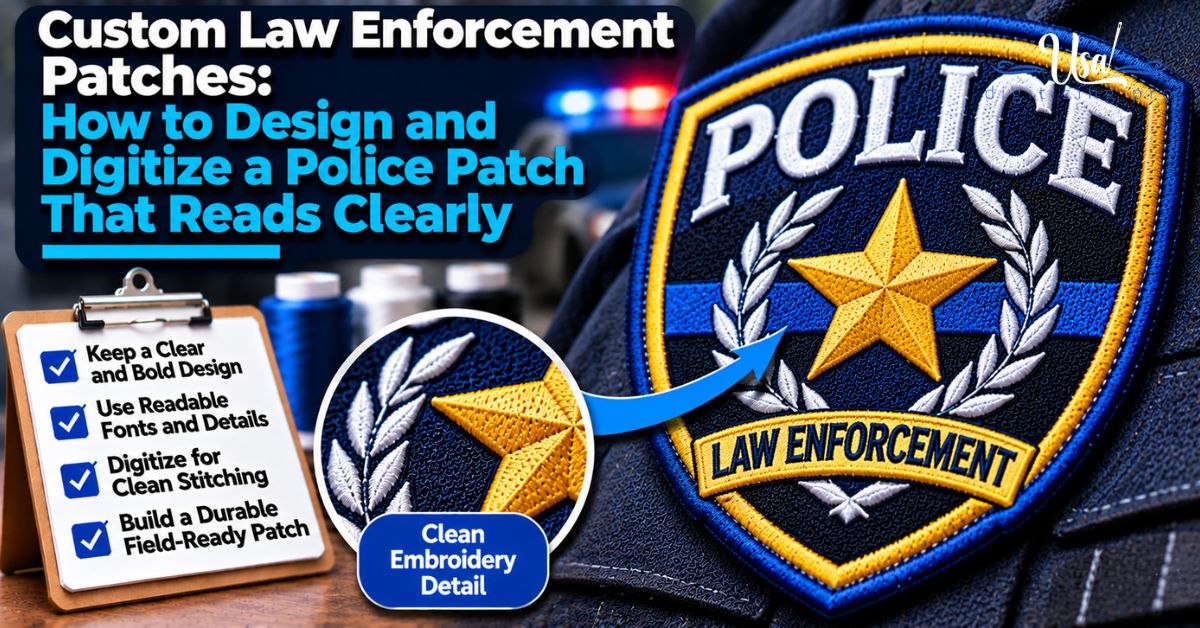
Every uniform shoulder in an agency carries the same patch. On it: the agency name, usually a state seal, sometimes a motto in small letters. That’s a lot to fit into a few inches of thread. Custom law enforcement patches succeed or fail on one thing. Readability. Can someone read the agency name from a few steps away? Does the seal still look like the seal? This post covers police patch design rules, what the stitch file needs and how to order. Our patch digitizing services build each file by hand for uniform suppliers and patch makers.
Quick Answer
Custom law enforcement patches should use bold, readable agency text, a simplified seal or emblem, a limited color set and a strong merrowed or satin border. The stitch file needs clean satin lettering, firm underlay on twill and careful handling of fine seal details. Orders should come from the agency or be authorized by it.
| Element | What works | Common problem |
|---|---|---|
| Agency name | Bold satin letters along an arc | Thin letters that close up |
| Seal or emblem | Simplified shapes, fewer lines | Fine linework that blurs |
| Motto or small text | Kept large enough or removed | Text below about 4mm |
| Colors | A limited, set palette | Too many shades for thread |
| Border | Merrowed or satin | Margin too small for merrowing |
| Backing | Twill, sew-on or hook-and-loop | Iron-on on duty uniforms |
Supplying an agency? Send the approved design and size to art@usadigitizingpro.com. Standard files are back in 2 to 4 hours.
Who Can Order Law Enforcement Patches?
The agency. Or a supplier working on its behalf. Many US states restrict who can make, sell or wear police insignia without authorization. Before producing official shoulder patches, get written approval from the department. Fan, memorial and charity designs that clearly aren’t official insignia follow different rules. Even so, copying a real agency’s seal is best avoided. It protects you. It protects the supplier and It protects the public too.
What Makes a Police Patch Design Work?
Readability comes first. The agency name should be the clearest thing on the patch. The main emblem comes second. Most department patches follow the same layout. The agency name runs in an arc across the top, the emblem or seal sits in the middle and a place name or motto finishes the bottom. It’s common because it reads at a glance. Keep it. Just give each part enough room that nothing crowds the border.
How Should Text Be Handled?
Bold satin letters. Kept large. Small text is where patches fail first.
It’s the standard for readable patch text. Letters below about 4mm tall tend to close up, until the word looks like a line of thread. Arc text needs extra care with spacing, since letters crowd on the inside of a curve. Is the motto too long to fit at a readable size? Shorten it. Or drop it from the patch altogether.
How Do You Handle Detailed Seals?
You simplify them. A printed state seal is full of fine lines, tiny text and shading that thread can’t match at patch size. The shapes people recognize are kept: the outline, the central figure, the main colors. The finest lines are removed or thickened. Tiny text inside the seal is usually dropped or swapped for simple shapes. Get the agency to approve the simplified seal before production. Some agencies with extremely fine seals at small sizes go with a woven patch instead of embroidery.
Which Colors Should You Use?
A short list of solid thread colors matching the department’s official ones. Fewer colors mean a cleaner patch and faster production. Gradients in the artwork have to become solid blocks. If the department has Pantone references, send them along. Subdued patches are requested a lot for tactical uniforms. They use muted tones like black, gray and tan with the same file layout. Only the thread palette changes.
Which Border and Backing Should You Choose?
Merrowed borders are the classic shoulder patch finish. Custom shapes may need a satin or hot cut edge. A merrowed edge needs a clear margin of about 3 to 4mm between the design and the patch edge. Twill is the usual backing, since it holds fine edges well. Duty uniforms normally get sew-on patches. Tactical gear tends to use hook-and-loop. Edges are compared in patch digitizing border types. Hook-and-loop setups are explained in custom Velcro patch digitizing.
What Does the Stitch File Need?
Firm underlay. Clean satin text. Controlled density. A border that matches the finish. Twill pulls under dense fills. Underlay and pull compensation keep the shapes true. The stitch order runs background shapes first, then detail, then text and finally the border. Name tapes and rank patches for the same uniform can be built as separate files, as covered in our post on custom name patches.
Here’s a typical adjustment. A uniform supplier sends in a county sheriff patch with a detailed state seal plus a two-line motto. The star and outline of the seal are kept. Its inner lines get thickened. The tiny text inside it is dropped. The motto moves to one larger line. Before the file is finalized, the agency signs off on the simplified proof.
What Should You Send With the Order?
Everything that affects the file:
| 1 | The approved artwork, ideally vector. |
| 2 | Patch size and shape. |
| 3 | Thread colors or Pantone references. |
| 4 | Border type and backing. |
| 5 | Any subdued color version needed. |
| 6 | Your machine format or your producer’s format. |
About the Author
USA Digitizing Pro Team. Patch files have been built by hand here since 2015 for US uniform suppliers, patch makers and organizations. Readable text and clean borders are what we check first.
Frequently Asked Questions
Each agency sets its own size in uniform policy; confirm it before the file is built.
Only with the department’s permission, since many states restrict making or selling official insignia.
A patch in muted colors like black, gray, olive or tan, common on tactical uniforms.
Both are used, with embroidery for durability and woven for very fine seal detail.
Years of regular washing, when the patch is embroidered on twill with a merrowed border and sewn on.
Twill with a sew-on finish, with hook-and-loop on tactical gear.
Order Clear, Readable Law Enforcement Patch Files
Custom law enforcement patches need bold text, simplified seals, a set palette and a solid border. They also need agency approval.
Follow Us

RELATED BLOGS
Sleeve Embroidery Size Limits by Garment: What the.
A sleeve isn't a flat panel, and the hoop that holds it in place while it stitches isn't square either. Sleeve embroidery.
Patch Digitizing Border Types: Merrowed vs Heat Cut.
Two identical patch designs can come out looking completely different depending on one decision made before digitizing even starts: how the edge.