

Cap Digitizing Services
Cap Digitizing Services Clean Hat Embroidery Files for Every Cap Type
Cap embroidery fails more often than any other garment type. The curved front panel, the center seam, the rigid bill and the limited stitching area all work against a file built for a flat surface. A left chest logo file run directly on a cap produces a design that fans outward, drifts off center or puckers along the seam. Cap digitizing is a separate skill from flat garment digitizing. It requires specific techniques that most auto digitizing tools and many generalist studios get wrong.
USA Digitizing Pro builds cap digitizing files from its Texas studio for embroidery shops, apparel decorators, sports teams, promotional product distributors and uniform suppliers across the United States. Every cap file is built by a human digitizer using cap specific pathing, curve compensation and underlay settings matched to the cap type you're running. Logos under 5 inches start at $15. Turnaround runs as fast as 2 to 4 hours. Rush service is free for first time customers.
Quick Answer
| Detail | Value |
|---|---|
| Starting price | $15 flat for logos under 5 inches |
| Complex artwork | Quoted above $25 before work begins |
| Turnaround | 2 to 4 hours for designs under 10,000 stitches |
| Same day delivery | Orders received before 3 PM CT |
| Rush service | Free for first time customers |
| File formats | DST, PES, EMB, JEF, VP3, EXP, HUS, XXX |
| Cap types covered | Structured, unstructured, snapback, trucker, fitted, beanie, visor |
| Guarantee | Unconditional money back if stitched sample doesn't match preview |
Why Cap Digitizing Is Different from Flat Garment Digitizing
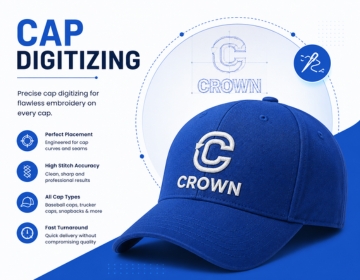
A polo shirt lies flat in the hoop. A cap does not. The front panel of a structured cap curves outward from the center seam in both directions. During embroidery, the machine drives the cap through a curved driver that holds the crown in position. Any design element that doesn't account for that curve will shift as the needle works outward from the seam.
The center seam itself is the thickest part of the cap front. Every structural cap has a ridge running top to bottom through the middle of the front panel. Needle penetration at the seam requires more force than anywhere else on the cap. A file that doesn't map stitch paths outward from that seam pushes fabric away from the center as the design progresses, leaving the finished logo off center on the finished garment.
The Center Out Technique
Professional cap digitizing builds every design from the center outward. The first stitches anchor the design at the center seam. Stitch paths then move left and right from that anchor point, keeping the fabric stable as the design grows. This approach counteracts the outward pull of the curved panel and keeps the design registered correctly from the first garment to the last garment in the run.
Design Size Limits on Caps
Most structured cap fronts have a safe stitching area of roughly 5 inches wide and 2.25 to 2.5 inches tall. Designs that exceed the height limit risk the needle contacting the metal frame of the cap driver, which damages both the needle and the machine. USA Digitizing Pro flags any artwork that exceeds safe cap dimensions before digitizing begins so the client can approve an adjusted layout before the file is built.
Cap Types We Digitize
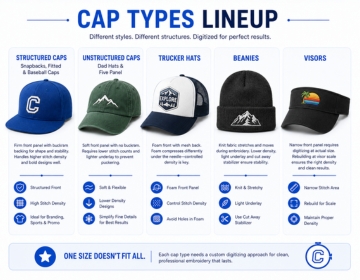
Different cap constructions behave differently under the needle. A six panel structured snapback and a five panel unstructured dad hat need completely different digitizing approaches. When the same file is applied to both, it results in a puckered mess on one and clean results on the other.
Structured Caps: Snapbacks, Fitted and Baseball Caps
Structured caps have a firm front panel held in shape by buckram backing. The rigidity helps the cap hold position in the driver during embroidery but also concentrates pull at the center seam. These caps handle higher stitch density and bolder designs than unstructured styles. They're the most common cap type for branded promotional apparel, sports team headwear and corporate giveaways in the US market.
Unstructured Caps: Dad Hats and Five Panel
Unstructured caps have a soft front panel with no buckram support. The fabric moves more during embroidery, which means higher density designs can produce visible puckering on the finished product. Digitizing for unstructured caps uses lower stitch counts, lighter underlay and simpler design layouts to keep the fabric stable throughout the run. Detailed logos with fine text often need simplification before they're suitable for unstructured cap placement.
Trucker Hats
Trucker caps combine a structured foam front with a mesh back. The foam front stitches similarly to a standard structured cap but with one extra consideration: the foam material compresses under the needle differently than woven fabric. Stitch density needs to stay controlled to avoid perforating the foam and creating holes that show through the design.
Beanies
Beanies are knit fabric with significant stretch. The same movement that makes a beanie comfortable to wear works against embroidery stability. Beanie digitizing uses lower density, lighter underlay and cut away stabilizer to manage fabric stretch during production. Designs with fine detail or small text rarely translate well to beanies and typically need simplification.
Visors
Visors have a very narrow front panel. The safe stitching height for a standard visor runs significantly shorter than a full cap front. Designs digitized for a full cap must be rebuilt at visor scale rather than simply scaled down, because scaling changes stitch density without adjusting pull compensation.
Cap Type Comparison
| Cap Type | Front Structure | Max Design Width | Key Digitizing Note |
|---|---|---|---|
| Structured snapback | Buckram backed firm panel | Up to 5 inches | Center out pathing essential at center seam |
| Fitted baseball cap | Buckram backed firm panel | Up to 5 inches | Same as snapback. Dense designs work well. |
| Dad hat (unstructured) | Soft no buckram panel | Up to 4.5 inches | Lower density. Avoid fine detail at small sizes. |
| Trucker hat | Foam front panel | Up to 5 inches | Control density to avoid foam perforation. |
| Beanie | Knit stretch fabric | Up to 4 inches | Cut away stabilizer. Simplified designs only. |
| Visor | Narrow front band | Up to 4 inches | Rebuild at visor scale. Don't scale from cap file. |
3D Puff Cap Digitizing
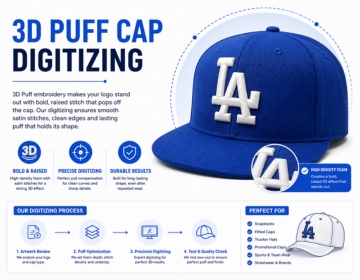
3D puff embroidery places a layer of foam beneath the stitches to create a raised dimensional effect on the finished cap. It's one of the most requested cap embroidery styles in the US market for sports teams, streetwear brands and premium corporate headwear. The raised effect reads boldly at a distance and photographs well on product listings.
Digitizing for 3D puff is technically distinct from flat cap digitizing. The foam layer changes how stitches behave. Only satin stitches are used in puff areas because fill stitch perforates the foam and creates a textured surface instead of a smooth raised block. Stitch spacing runs tighter than flat digitizing to fully cover the foam edges. A center line tack down stitch secures the foam before the main satin columns go down. End caps on each satin column close the foam edges so the material doesn't push through at the sides of the design.
Fine detail, small text and gradients do not work in 3D puff. The raised nature of the format requires bold, clean shapes with clear outlines. USA Digitizing Pro reviews every 3D puff order for design suitability before digitizing begins. If any element won't translate cleanly to the puff format, the studio flags it and offers a flat alternative or a hybrid approach where puff and flat stitching appear in the same design.
What Happens When Cap Digitizing Goes Wrong
Design drift is the most common cap digitizing failure. The logo starts centered on the cap front but ends two to three millimeters off center by the time the machine finishes the run. On a small cap logo this is visible immediately. The cause is almost always a file built without center out pathing.
Seam puckering shows up as a raised ridge along the center seam beneath the design. The thread tension at the seam pulls the panel fabric inward. A properly built cap file accounts for this pull by adjusting stitch width near the seam. Auto digitized files never make this adjustment.
Text closing up on caps is a persistent problem for any logo with lettering below about 5mm cap height. At that size, standard satin column widths fill the open counters of letters. The word stitches as a solid stripe instead of readable text. Professional cap digitizing widens the letter columns and reduces density specifically for small cap lettering to keep each character open and legible on the finished garment.
Thread breaks at the seam happen when a file sends the needle through the thickest point of the cap at maximum speed with no adjustment for the added resistance. A properly built cap file reduces stitch length near seams and ramps stitch speed at crossing points to protect both the needle and the cap material.
File Formats We Deliver for Cap Digitizing
Different embroidery machines run different native formats. Requesting the right format at the time of order eliminates conversion errors and quality loss.
- DST (Tajima): The most universally accepted format. Runs on virtually every commercial multi head machine in the US. Request this if you're unsure what format your machine uses.
- PES (Brother): Standard for Brother commercial and home machines. Very common in US embroidery shops.
- EMB (Wilcom): Native Wilcom format. Stores full editing data for shops that need to adjust the file after delivery.
- JEF (Janome): For Janome machines common in smaller studios and home operations.
- VP3 (Husqvarna Viking): For Husqvarna and Viking machines.
- EXP (Melco): For Melco commercial systems.
Request multiple formats in the same order at no extra charge. If your shop runs both Brother and Tajima machines, both PES and DST ship with the same order.
How to Submit Your Cap Digitizing Order
- Send your logo file. AI, EPS, SVG or high resolution PNG all work. The cleaner the input file the faster the digitizing.
- Specify the cap type: structured, unstructured, trucker, beanie or visor.
- State whether the design is flat embroidery or 3D puff.
- Note the maximum design width you need. Most cap fronts fit a design up to 5 inches wide. If you're unsure, note the cap model and we'll advise the right size.
- List the machine format you need. If you run multiple machine brands, list all required formats.
- Include thread color preferences or Pantone references if your brand has approved color standards.
- Submit at usadigitizingpro.com. Standard cap files deliver in 2 to 4 hours for designs under 10,000 stitches. Orders received before 3 PM CT ship same business day.
Who Uses Our Cap Digitizing Service
Embroidery contract shops use USA Digitizing Pro for daily volume work on cap orders where their in house digitizer is at capacity or unavailable. The wholesale program starts at 25 designs per month with per design pricing, dedicated account management, NDA coverage on every client artwork file and bulk ZIP packaging organized in the folder structure the shop specifies.
Sports teams and leagues order cap front logos and side panel designs for game day headwear, staff caps and fan merchandise. Team orders benefit from consistent file quality across a season's worth of headwear SKUs.
Promotional product distributors use the service to support clients who need cap embroidery as part of a branded merchandise program. The fast turnaround means a client's order confirmation today translates to a production ready file the same afternoon.
Uniform suppliers handling multi location corporate accounts rely on clean cap files to maintain logo consistency across different embroidery vendors running different machine brands. Delivering the same design in DST, PES and JEF from one studio ensures every vendor stitches the same approved result.
Pricing and Turnaround
Cap front logos under 5 inches wide run a flat $15 with no additional charges for the curve compensation, cap specific pathing or the standard digital proof. Complex artwork with high stitch counts, detailed elements or 3D puff requirements is quoted above $25 before work begins. The quoted number is the final number. No setup fees. No file format fees.
Standard turnaround is 2 to 4 hours for cap designs under 10,000 stitches. Any order received before 3 PM CT ships the same business day. First time customers automatically receive free rush service, which moves their order to the front of the queue at no extra charge. Every cap file ships with an unconditional money back guarantee. If the stitched sample doesn't match the digital proof, USA Digitizing Pro redoes the file or issues a full refund without questions.
Frequently Asked Questions About Cap Digitizing
No. A flat garment file applies standard pathing, density and underlay settings built for flat fabric in a flat hoop. A cap front is curved, has a rigid center seam and sits in a curved driver during embroidery. Running a flat file on a cap produces design drift, seam puckering and misregistration. The cap version of a logo needs to be rebuilt with center out pathing, cap appropriate underlay and pull compensation adjusted for the curved surface.
For most standard structured caps the safe area runs up to 5 inches wide and 2.25 inches tall. Exceeding the height limit risks the needle hitting the metal cap driver frame. Width limits depend on the specific cap model. USA Digitizing Pro confirms safe dimensions for each cap type before digitizing begins. Designs submitted wider or taller than the safe area are flagged for client approval on an adjusted layout before any work starts.
3D puff places a foam layer beneath the stitches to create a raised dimensional surface. The digitizing approach differs from standard flat cap work in several ways: only satin stitches work in puff areas, stitch spacing runs tighter to fully cover foam edges, a tack down run secures the foam before main stitching begins and end caps close the foam at column edges. Fine details and small text don't work in puff format. Any puff design with elements that won't translate cleanly gets flagged before work begins.
Request the native format for your machine brand. DST works on virtually all commercial Tajima multi head machines and most other commercial systems in the US. PES is standard for Brother machines. JEF works on Janome. VP3 covers Husqvarna Viking. If you run multiple machine brands in your shop, request all formats in the same order. USA Digitizing Pro delivers multiple formats from a single cap file at no additional charge.
Yes. Front panel, side panel and back panel placements are all handled. Side panels have different size constraints than front panels and the curved geometry differs slightly depending on the panel position. Each placement is a separate digitized file built for that specific position on the cap. If you need front and side panel files for the same logo in the same order, note both placements at submission and both files ship together.
Designs with bold shapes, clean outlines and text at 5mm cap height or larger translate well to cap embroidery. Designs with very fine lines, gradients, photographic detail or text below 4mm height typically need simplification before they stitch cleanly on a cap. USA Digitizing Pro reviews every submitted design before digitizing and flags anything that may not produce a clean result at the specified cap size. If simplification is needed, the studio recommends the adjustment and gets client approval before work begins.
Start Your Cap Digitizing Order Today
Your cap logo deserves a file built for the surface it's going to stitch on. A cap file built by hand, with center out pathing, correct underlay and cap specific pull compensation produces a clean consistent result from the first hat to the last in every production run.
USA Digitizing Pro handles cap digitizing for embroidery shops, sports teams, promotional distributors and uniform suppliers across the US. Logos under 5 inches start at $15 flat. 3D puff and complex artwork is quoted before work begins with no surprises. Turnaround runs as fast as 2 to 4 hours.