

Custom Velcro Patch Digitizing: The Stitch File Behind Every Hook and Loop Patch
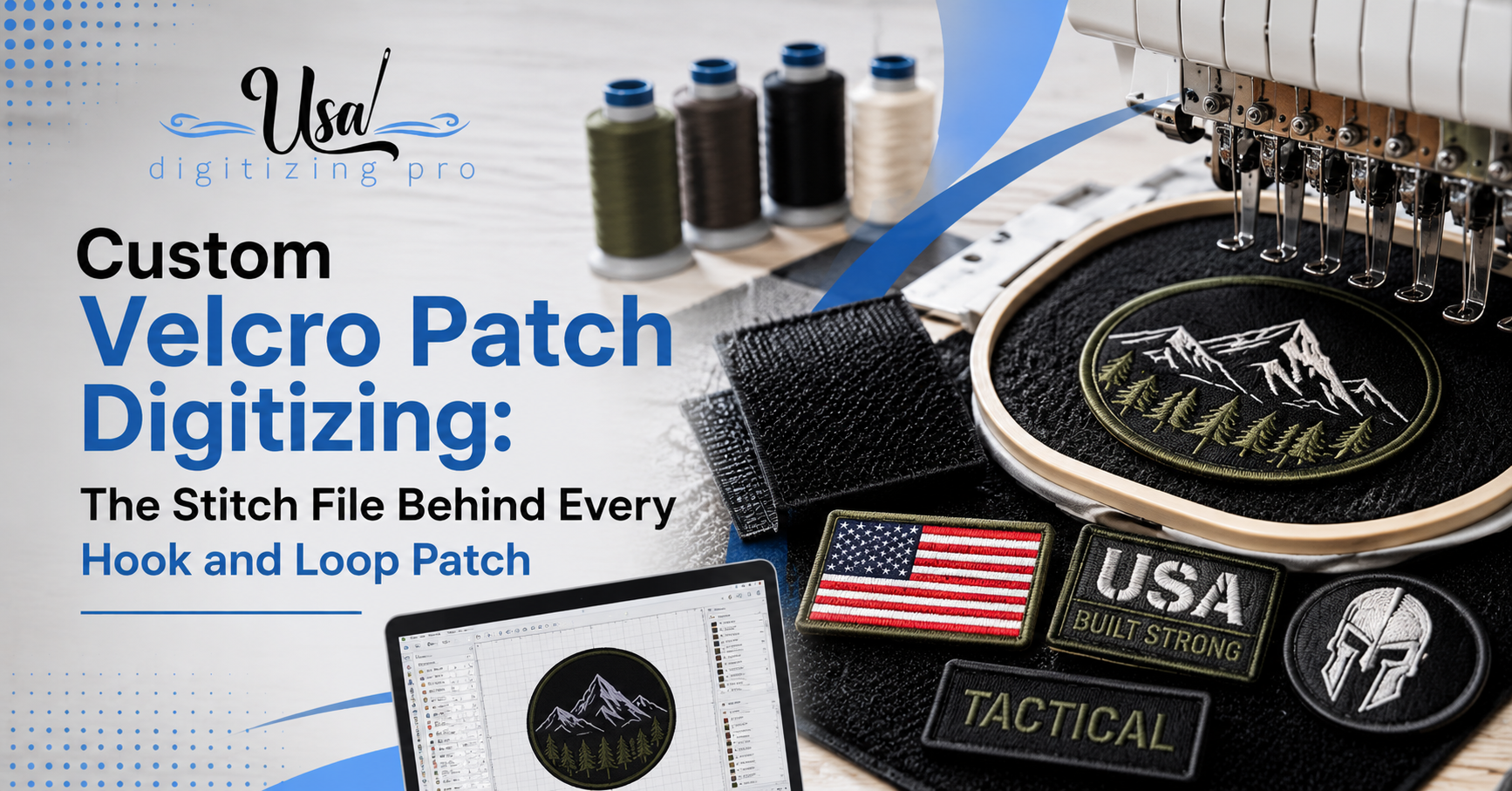
USA Digitizing Pro is a Texas-based embroidery digitizing studio founded in 2015. The team builds machine-ready stitch files for patch programs, apparel decorators, and uniform suppliers across the USA.
Hook-and-loop patches are everywhere. Tactical vests, military uniforms, law enforcement gear, sports jackets, and branded merchandise all use them. The reason is simple, they attach and remove without damaging the garment, they can be swapped between pieces, and they look sharp when the embroidery behind them is done right. The embroidery is the part that matters most. A custom velcro patch digitizing file determines whether the patch looks clean from edge to edge or whether thread gaps, border fraying, and blurred detail undercut the whole design.
USA Digitizing Pro builds patch stitch files for hook-and-loop programs of all types from unit morale patches to corporate uniform programs and sports team gear. Every file is hand-built. Starting at $15 for designs under 5 inches with a 2 to 4 hour turnaround. View completed patch work at the portfolio before placing your order.
Quick Answer
What Custom Velcro Patch Digitizing Is
Velcro patch digitizing: the process of building a machine embroidery stitch file for a patch design that will be produced on a separate backing material and finished with a hook-and-loop attachment system on the back.
The Velcro backing itself is a production step that happens after the embroidery machine finishes the patch. The digitizing file handles everything the machine does — where every stitch goes, what type of stitch covers each element, how the border run is placed for the cut line, and what order the thread colors sew. The quality of the file is what determines whether the finished patch has clean edges, solid color coverage, and border stitching that holds after the patch is handled and reattached hundreds of times.
Get the digitizing file wrong and no amount of quality backing material fixes a border that frays, text that blurs, or fill sections with gaps showing the backing fabric underneath.
How Hook-and-Loop Backing Works on Embroidered Patches
Hook-and-loop fastening — commonly called Velcro, which is a brand name — uses two mating surfaces. The hook side is covered in tiny rigid loops that grip. The loop side is a softer woven surface that the hooks catch onto. For patches, the hook side is attached to the back of the finished embroidered patch. The loop field is sewn onto the garment, vest panel, or gear surface.
Hook Side on the Patch
The hook side goes on the patch back. It’s typically glued or heat-bonded directly onto the patch backing after the embroidery is finished and the patch is cut to shape. Military-standard patches use a hook backing approximately 80 percent of the patch area to maximize hold on MOLLE loop fields.
Loop Side on the Garment
The loop panel is sewn or heat bonded to the garment or gear surface. Most tactical vests, plate carriers, and MOLLE-compatible bags have loop fields already integrated. For uniforms and jackets without existing loop panels, a loop field section is sewn on separately before the patch system is used.
Why Removability Matters
The practical advantage of hook-and-loop patches over sew-on patches is the ability to swap without damage. A soldier can change unit patches between assignments. A law enforcement officer can update rank or division patches without the garment going to a tailor. A brand can update a seasonal patch on a product line without replacing the entire garment. The patch system is what makes this possible. The stitch file is what makes the patch itself worth swapping in.
What Makes a Velcro Patch Digitizing File Different from Direct Embroidery
Patches stitch onto a separate backing material before being applied to a garment. The backing substrate typically twill, felt, or canvas — behaves differently from a shirt or jacket fabric. That difference changes how the stitch file needs to be built.
Border Run Placement
Every patch file needs a precise border run stitched at the cut line position. This tells the cutting machine or operator exactly where to cut the patch to shape. A direct chest embroidery file doesn’t have this — it stitches onto the garment with no cut requirement. Get the border run wrong and the patch cuts into design elements or leaves too much backing showing at the edge.
Density Settings for Patch Backing
Patch backing materials are stiffer and less forgiving than woven garment fabrics. Stitch density on patch backing needs to be calibrated for the substrate. Too high and the needle perforates the backing aggressively, weakening the material around the stitch holes. Too low and the fill coverage has gaps. A skilled digitizer sets density differently for a twill patch than they would for a polo shirt or jacket.
Border Type Affects the File
The finishing method for the patch edge changes what the stitch file needs to include. A merrow border is finished by an overlock machine after embroidery the digitizing file needs a clear margin around the design for the overlock to work without cutting into stitches. A satin stitch border is built directly into the file as a wide satin column around the outer edge. A hot-cut or laser-cut patch needs only the run stitch at the cut line. The digitizer needs to know the border type before building the file.
For a detailed look at how each border type affects file construction and production outcome, the patch chest digitizing overview covers all four border types and their specific requirements.
Standard Sizes for Hook-and-Loop Patches
The 2×3 inch rectangle is the tactical standard. It fits MOLLE loop fields on most plate carriers and vests sold in the USA and is the size most morale patch culture revolves around. If you’re not sure what size to use, this is the safe default.
The Digitizing Process for a Custom Hook-and-Loop Patch
Here’s how a velcro patch stitch file is built at USA Digitizing Pro from artwork to delivery:
- Submit the logo or design file (PNG, JPEG, PDF, AI, or EPS) with the patch size, backing material (twill, felt, canvas), and border type (merrow, hot-cut, laser-cut, or satin stitch border).
- The digitizer reviews the artwork at the target patch size. Fine detail that won’t hold at small dimensions is flagged for simplification.
- A border run is digitized first. This marks the exact cut line the patch finishing machine will follow.
- Underlay is set manually for the backing material type. Each substrate — twill, felt, canvas — needs different underlay settings.
- Fill and satin sections are digitized with density calibrated for the backing. Color sequence is ordered to minimize thread changes.
- Text is rebuilt for the output size. Letters below about 5mm cap height get stroke adjustments or are switched to run stitch for legibility.
- The complete file is reviewed for path logic, trim placement, and border precision before export.
- Delivered in your required machine format (DST, PES, JEF, VP3, and others) within 2 to 4 hours. Free edits available after delivery.
Patch Orientation and the Hook-Side Placement Problem
Here’s a detail most digitizing guides skip entirely: the orientation of the patch matters for how the hook-and-loop backing is applied.
An embroidered patch has a clear top and bottom — the design reads right-side up in one orientation only. When the hook backing is applied to the patch back, it needs to be applied with the hook pile running in the correct direction relative to the patch design. If the hook side is applied rotated 90 degrees from standard, the patch won’t sit flat in the expected orientation when mounted to a loop field on tactical gear.
This is a production floor detail, not a digitizing file detail — the file can’t enforce hook orientation. But a good digitizer includes a note in the file delivery specifying top and bottom of the design so the production team applies the hook backing correctly. USA Digitizing Pro includes orientation notes for complex or non-obvious patch shapes in the delivery documentation. If you’re running production for the first time on a new patch design, ask for this note upfront.
Running Multiple Patch Designs Across a Program
Uniform programs and unit patch collections rarely involve a single patch design. More commonly, a program needs 4 to 8 patch variants — a main unit crest, a rank patch, a name tape patch, a morale patch, and possibly division or specialty patches. Each needs its own stitch file.
The hidden risk in multi-patch programs is inconsistency between files built at different times or by different digitizers. A crest patch and a name tape patch that were built six months apart with different density settings won’t match in thread coverage or border weight when worn side by side on the same vest. They look like they came from different sources. Because they did.
Briefing a multi-patch program as a single order to one digitizer solves this. The same density standards, the same border weight approach, and the same color sequence logic are applied across all files in the set. The patches look like a system rather than a collection of individual items. USA Digitizing Pro handles multi-file patch programs as a single brief — send the full program artwork list, the backing and border specs, and the team builds all files with consistent settings.
If the program also includes cap or left chest placement alongside patches, the left chest digitizing service and cap digitizing overview cover the specific file differences for those placements.
Who Orders Custom Velcro Patch Digitizing
Military units and special operations communities are the core buyers. A unit crest or callsign patch on a plate carrier is part of identity in deployed environments. These patches get handled constantly — attached, removed, stored, reattached — and the stitch file quality determines how well they hold up through that cycle.
Law enforcement tactical teams, SWAT units, and K9 divisions run similar programs. Badge patches, unit identifiers, and rank patches on tactical vests all use hook-and-loop systems for easy field updates.
Sports teams run hook-and-loop patches on warmup jackets, sideline gear, and staff vests. Promotional merchandise programs use velcro patch files for branded gear collections. Airsoft and military simulation teams build unit patch programs that mirror real tactical culture. For a broader look at how morale patch culture drives velcro patch demand, the custom morale patch guide covers the full buyer landscape.
Real Production Scenario
A Charlotte-based law enforcement equipment supplier needed patch stitch files for a county sheriff’s department uniform program. The program included a 3-inch round department crest, a 2×3 rectangle rank patch in five variants, and a 2×3 rectangle name tape patch for personalization.
All seven files were briefed as a single program order to USA Digitizing Pro. The same border weight — a 4mm satin column — was applied across all patches. Density was set for twill backing at a consistent 0.38mm line spacing across all fill sections. The department crest had a fine star detail at the center that was simplified to a clean five-point shape at the 3-inch diameter.
The supplier ran all seven files across 85 complete patch sets for initial uniform issue. Zero thread breaks across the run. The crest and rank patches matched visually on the finished uniforms. The department reordered the name tape files six months later for new hire kits. Same files, same quality.
Get Your Custom Velcro Patch Digitizing File
A hook-and-loop patch that looks sharp and holds up through repeated attachment cycles starts with a stitch file built for patch production — correct border run placement, density calibrated for the backing material, and text rebuilt to the actual output size. USA Digitizing Pro builds every custom velcro patch digitizing file by hand with a money-back quality guarantee. Starting at $15 for designs under 5 inches with a 2 to 4 hour turnaround.
Frequently Asked Questions
The Velcro backing is applied to the patch after the embroidery is finished — it’s a separate production step and doesn’t change the stitch file itself. What does change between a patch file and a direct-garment file is the border run, the density settings for the backing substrate, and the margin requirements for the chosen finishing method. A patch file is built for a separate backing material and has a cut-line border built in. A standard garment file doesn’t have those elements.
The hook side goes on the back of the embroidered patch. The hook pile consists of rigid loops that grip onto the softer loop field. The loop field is sewn onto the garment, vest, bag, or gear panel. When you press the patch against the loop panel, the hook side catches the loops and holds the patch firmly. To remove, peel the patch away from the loop field. Hook-backed patches can be reattached to any compatible loop field repeatedly without losing grip.
Minimum stitch count for patch structural integrity depends on patch size and design complexity. A standard 2×3 inch hook-and-loop patch typically runs between 5,000 and 12,000 stitches depending on design density. The border run and satin border column add stitch count on top of the design elements. Very low stitch count designs on large patches can result in the backing fabric showing through fill sections. A professional digitizer sets density to ensure full coverage without over-stitching.
With caveats. The stitch path and design elements stay the same. But pull compensation and density settings in the file are calibrated for a specific substrate. A file built for twill backing may run with slightly different coverage on felt or canvas because those materials respond differently to needle pressure. For programs where the same design runs on multiple backing types, ask the digitizer to note the calibration target and flag if any adjustment is recommended for a different substrate.
Loop field material is sold in strips and panels by width and length. For uniforms, the standard approach is to sew a loop panel to the chest or sleeve at the intended patch position using a sewing machine with a heavy-duty needle. The loop material is stitched around its perimeter to the garment. Alternatively, some loop panels have an iron-on adhesive backing for temporary application, though sewn loop panels hold more reliably through repeated wash cycles. The patch hook side then attaches directly to the sewn loop panel.
The same formats as any embroidery file: DST for Tajima and most commercial machines, PES for Brother and Babylock, JEF for Janome, VP3 for Husqvarna Viking and Pfaff, and others. The format depends on the embroidery machine running the patches, not the backing type. USA Digitizing Pro delivers patch stitch files in any format the production machine requires. Specify your machine brand and model when ordering and the team matches the format automatically.
Follow Us
Follow Us

RELATED BLOGS

Vector File Formats Explained: AI vs EPS vs.
Ask a printer or sign shop for artwork and they'll often name a specific format instead of just saying vector file. Vector.
1 COMMENT
Great content! Keep up the good work!
Comments are closed.