

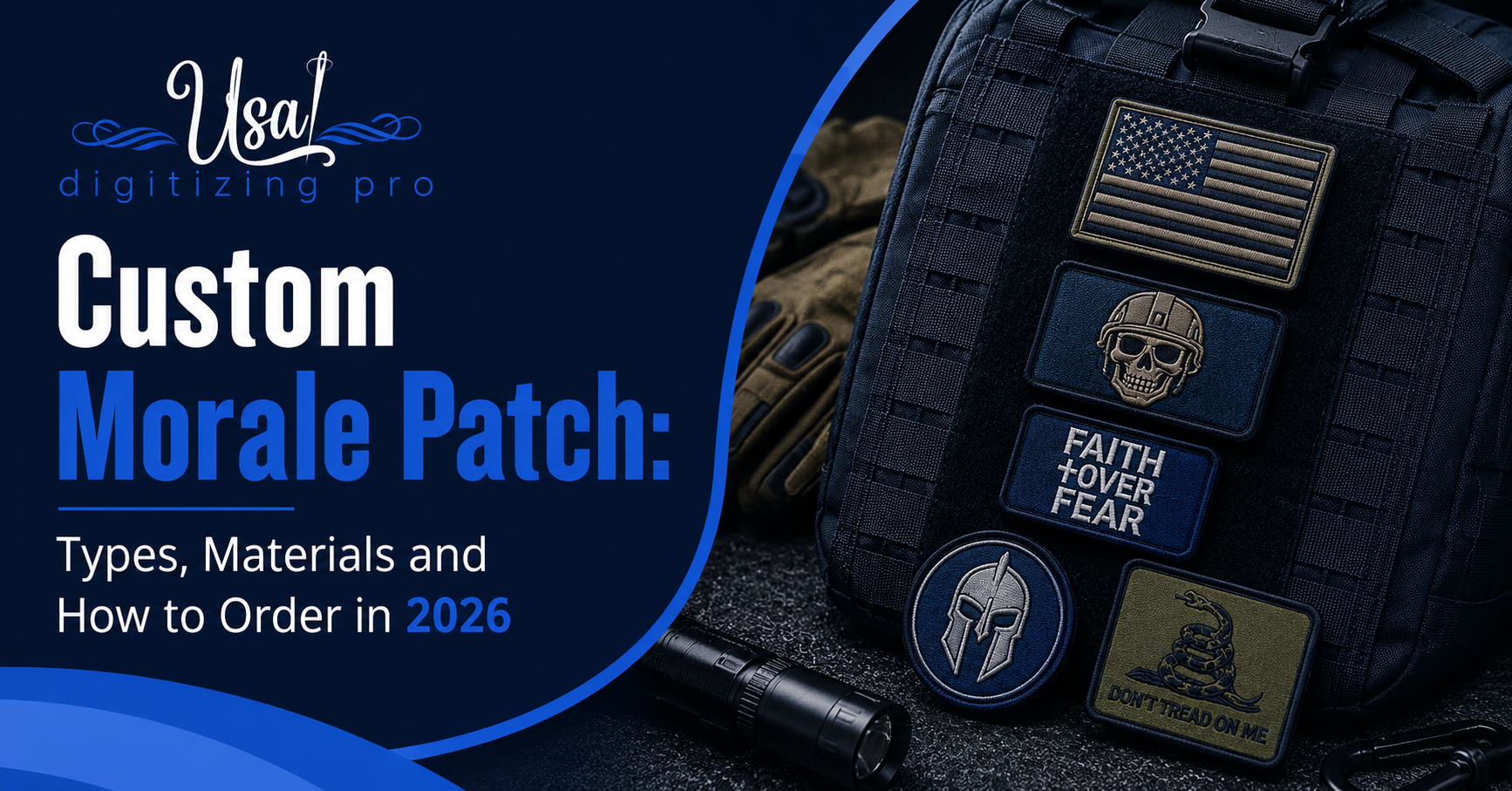
Custom Morale Patch: Types, Materials and How to Order in 2026
USA Digitizing Pro is a Texas-based embroidery digitizing studio founded in 2015. The team handles stitch file production for apparel brands, tactical gear suppliers, and custom patch programs across the USA.
Most people who want a custom morale patch run into the same wall. They’ve got a design idea, a unit name, or a concept that would make a great patch. What they don’t know is which material to pick, what backing works on their gear, and whether the stitch file behind the design will hold up in real use. The wrong choice results in a patch that looks cheap, falls off, or loses detail after a few wears. This post covers everything you need to know before you order.
From embroidered to PVC to woven, from hook-and-loop to iron-on, from 2-inch team crests to large back patches — this is the full breakdown. And if you need the digitizing file that makes a custom embroidered morale patch actually run clean on a machine, that’s exactly what USA Digitizing Pro does.
Quick Answer
What a Morale Patch Actually Is
Morale patch: an unofficial patch worn alongside standard uniform insignia to express unit culture, inside humor, personal identity, or team spirit. Unlike regulation military patches that follow strict heraldry rules, morale patches operate outside the official approval chain.
The tradition started in World War II. Aircrews began painting nose art on their aircraft and wearing unofficial unit emblems on flight jackets. The custom carried through Korea, Vietnam, and into modern deployments. By the time the Global War on Terror was underway, morale patches had become a fixture of plate carrier culture — collected, traded, and worn as a visible expression of what a unit had been through together.
Today the audience goes well beyond active military. Law enforcement tactical units, fire department companies, airsoft teams, hunting clubs, mountain climbing crews, first responder units, and brand merchandise programs all use morale patches for the same reason: a small piece of fabric or rubber that says something about who you are and what you’re part of.
Types of Custom Morale Patches: Which Material Fits Your Use
The material determines everything — how the patch looks, how it holds up, and how much detail the design can carry. Here’s how the main options compare:
Embroidered Morale Patches
The classic choice. Thread stitched over a twill or felt backing. Embroidered patches have a textured, three-dimensional feel that other types don’t replicate. They work well for logos, text, and graphic designs that don’t require gradients. The thread count limits the finest details — very small text or intricate line art simplifies in embroidery. Durable through washing and outdoor use.
The digitizing file behind an embroidered patch is what determines stitch quality. A poor file produces gaps at the border, thread breaks during production, and blurred text at small sizes. A hand-built file from a skilled digitizer produces a patch that runs clean from the first piece to the last in a bulk order.
PVC and Rubber Morale Patches
PVC patches are molded soft rubber. They’re weather-resistant, waterproof, and hold fine detail better than embroidery at small sizes. Colors are vivid. 3D raised effects are possible. They don’t require a digitizing file — PVC patches are produced from a mold rather than a stitch file. The tradeoff is feel: PVC is stiffer than thread and doesn’t have the fabric texture collectors prefer.
For tactical gear in wet or muddy environments, PVC holds up where embroidered patches absorb moisture and can fade over time.
Woven Patches
Woven patches use a different production method than embroidery — the design is woven directly into the fabric rather than stitched on top of it. The result is a thinner, flatter patch with finer detail reproduction than standard embroidery. Woven patches suit designs with small text, tight linework, and complex logos that don’t translate well to thread at small scales.
Dye Sublimation Patches
Sublimation printing transfers a design directly into the patch material using heat and dye. It reproduces photo-quality images and gradients that neither embroidery nor PVC can match. The surface is flat. Colors are unlimited. The downside is durability: sublimation patches fade faster than embroidered or PVC versions under UV exposure and repeated washing.
Leather Patches
Leather morale patches carry a specific aesthetic — rugged, classic, higher-end looking than fabric options. Used for collector patches, motorcycle club marks, and premium brand merchandise. Laser engraving is common on leather. Stitching into leather requires a different production approach than fabric patches and needle holes in leather don’t close after sewing.
Backing Types: How the Patch Attaches to Your Gear
The backing decides where and how the patch stays in place. Get this wrong and the design looks great but falls off the first time it sees real use.
Hook-and-Loop (Velcro)
The standard for tactical and military morale patches. The hook side attaches to the patch back. The loop field on your plate carrier, vest, or backpack receives it. Easy to swap out, reposition, or collect without damaging gear. Hook-and-loop patches are the universal format for MOLLE-compatible tactical setups and nearly all military morale patch culture runs on this system.
Iron-On Backing
Heat-bond adhesive on the patch back. Press it to a garment with an iron and it bonds to the fabric. Convenient for applying patches to jackets, bags, and clothing without sewing. Not suitable for gear that sees heavy use or frequent washing — the bond weakens over time and re-ironing is required to keep the patch secure.
Sew-On (No Backing)
An unfinished patch edge that gets stitched directly onto the garment by hand or machine. The most permanent option. You can’t remove it without cutting stitches and leaving marks on the garment. Used for regimental patches, official insignia, and any patch meant to stay put indefinitely.
Pin Backing
A metal pin and clasp on the back, like a pin badge. Used for collector patches that display on a board, bag, or hat brim rather than being sewn or bonded to gear. Not suitable for tactical use.
Size Standards for Morale Patches
Size matters for function, not just aesthetics. Tactical gear has specific loop field dimensions. A patch that’s too large won’t fit the panel. One that’s too small looks lost.
The 3×2 inch rectangle is as close to a universal standard as this category has. It fits the majority of MOLLE-compatible loop fields and is the first size most buyers default to.
What Makes a Good Morale Patch Design
A patch that works on gear is not the same as a design that looks good on a screen. Here’s what actually holds up at 2 to 3 inches.
Keep Text Bold and Short
Fine serif fonts at small sizes blur in embroidery and even in PVC at the lower end of the size range. Bold sans-serif text at 6mm cap height or above reads cleanly. A unit name, callsign, or short phrase works. A paragraph doesn’t. The most memorable morale patches say everything they need to in five words or fewer.
Limit Colors
Embroidered patches with more than 8 thread colors get expensive fast and take longer to produce. Most strong morale patch designs use 3 to 6 colors. High contrast between background and foreground elements makes the design readable from a distance. Low-contrast color choices on small patches look muddy in production.
Simple Shapes Over Complex Illustrations
A skull, a flag, a bolt of lightning, a compass rose — shapes that read instantly at arm’s length. Complex detailed illustrations that look great at full size on a screen compress into a blob at 3 inches. If you’re creating an original design, sketch it at the actual target size before committing. What reads at 3 inches is your design. What reads at 12 inches on your monitor is not.
Border Shape Matches the Content
A shield border on a military crest. A round border on a team logo. A custom irregular border for a brand patch. The border shape adds meaning. It’s also part of the production cost — simple geometric borders cut cheapest, complex custom die-cut shapes cost more. Know your budget before designing a 12-point star border.
The Stitch File Behind an Embroidered Morale Patch
This is the part most morale patch buyers never think about until something goes wrong.
An embroidered patch starts with a digitizing file. That file tells the embroidery machine exactly where every stitch goes — which type, what direction, how dense, and in what order. A poorly built file produces patches that run inconsistently across a batch, with thread breaks on complex sections and gaps at the border edge where the background fabric shows through.
A well-built file runs cleanly from the first patch to the five hundredth. The border run sits precisely at the cut line. Satin columns cover the design edge-to-edge. Text letterforms are built for the actual sew-out size, not scaled from a larger design. That’s what hand-built digitizing produces versus a file run through auto-digitizing software. USA Digitizing Pro builds every patch file by hand, starting at $15 for designs under 5 inches, with a 2 to 4 hour turnaround. For the full technical breakdown of how patch files are built, patch digitizing services covers the process in detail.
Who Orders Custom Morale Patches and Why
Military units and special operations communities are the core buyer. Morale patches on plate carriers and deployment bags are a marker of what a team has done together. A patch represents a deployment, a training event, a unit callsign, or an inside reference that means everything to the people in the room and nothing to anyone outside it.
Law enforcement tactical units and fire department companies run similar programs. A SWAT team patch for a department activation. A firehouse crest for company gear. K9 unit patches. First responder memorial patches for fallen colleagues.
Outside the uniformed services, airsoft and paintball teams run morale patches on vests and chest rigs to build unit identity. Hunting and outdoor groups use them on range bags and day packs. And then there are the collectors, who trade patches the way some people trade baseball cards. A limited run morale patch from a specific operation or unit can command real secondary market interest.
Brands and merchandise programs use morale patches as a product line. A patch attached to a hat, jacket, or bag extends the brand onto gear in a way a printed logo doesn’t. If the morale patch design also needs to appear as a sewn-on badge, how to sew on embroidered patches covers the attachment methods and what each requires from the patch backing.
How to Order a Custom Morale Patch Digitizing File
If you’re going to an embroidery shop or running patches on your own machine, you need the digitizing file first. Here is the process:
- Finalize the design at the actual target size. What the design looks like at 3 inches is what matters.
- Choose your material: embroidered, PVC, woven, or sublimation. Each has different production requirements.
- Choose your backing: hook-and-loop, iron-on, sew-on, or pin.
- Determine your border type: merrow edge, hot-cut, laser-cut, or satin stitch border.
- Send the artwork file (PNG, JPEG, PDF, AI, or EPS) to sales@usadigitizingpro.com with the target size and backing details.
- The digitizer reviews the design for stitch-readiness and builds the file by hand.
- The file lands in your inbox in 2 to 4 hours in your machine’s required format (DST, PES, JEF, VIP, VP3, HUS, EMB, or others).
- Run a test sew-out before the full production batch.
Real Example: Patch Program for a Tactical Training Unit
A private tactical training company in Texas needed custom morale patches for their instructors and course graduates. The design was a skull with crossed rifles, a compass in the background, and the company callsign below it. They wanted 3×2 inch patches with hook-and-loop backing on twill.
USA Digitizing Pro built the digitizing file with the skull and background handled as separate fill sections, the crossed rifles as satin elements, and the callsign text rebuilt at bold weight for the 3×2 target size. The fine compass detail in the background was simplified to a four-point cardinal indicator that read cleanly without muddying the center design.
The file ran 200 patches without a single thread break. The company re-ordered six weeks later with a second design for an advanced course graduation. Same file quality standards, same turnaround.
Next Step: Start Your Patch Design
A custom morale patch tells a story in a 3-inch square. Getting the design right is about simplicity, contrast, and choosing the material that fits the actual use. Getting the stitch file right is about hiring a digitizer who builds by hand and knows what an embroidered patch needs to sew cleanly through a production run.
Frequently Asked Questions
Standard military patches are regulation insignia — unit crests, rank insignia, and branch patches that must meet official specifications and placement rules set by the relevant branch of service. Morale patches are unofficial. They sit outside the regulation uniform system and are worn on tactical gear, range bags, and jackets rather than the formal uniform. The designs are self-directed and range from serious unit identity marks to dark humor that only insiders understand. Both can be embroidered, but morale patches don’t require approval from military heraldry offices.
Minimum order quantities vary by manufacturer and patch type. PVC patches typically have higher minimums because mold production requires setup costs that spread across a batch. Embroidered patches from many USA suppliers start at 10 to 12 pieces. For the digitizing file only, there’s no minimum — you order one file per design and your production shop runs however many patches you need from it. If you’re running patches in-house on your own machine, you control the quantity entirely from the stitch file.
Hook-and-loop backing is the standard for MOLLE-compatible gear. The hook side attaches to the back of the patch. The loop field on the plate carrier, vest, or bag receives it. Standard military loop fields are sized for 2×3 inch patches, though many carriers have larger loop panels that accommodate bigger designs. Hook-and-loop patches can be moved, swapped, or removed without tools and without damaging gear, which is why the format dominates tactical patch culture.
Digitizing file delivery from USA Digitizing Pro takes 2 to 4 hours. Actual patch production time at an embroidery shop depends on quantity and current workload. A small run of 50 embroidered patches typically takes 5 to 10 business days from file approval to shipping. PVC patches take longer because mold production and casting add time. Large orders of 500 or more need 2 to 4 weeks depending on the producer. Rush options are available at most USA embroidery studios for a premium.
The required format depends on the machine brand. Tajima machines use DST. Brother machines use PES. Janome machines use JEF. Husqvarna and Pfaff machines use VIP or VP3. Barudan machines use their own proprietary format. USA Digitizing Pro delivers the file in whatever format you specify. If you don’t know your machine’s format, mention the machine brand in the order and the team will match it automatically.
Technically yes but practically no, not without rebuilding. A stitch file built for a 3×2 inch patch can be mathematically scaled to 4×3, but the stitch density, column widths, and text simplifications were all set for the original size. Scaling a file changes dimensions but not the stitch decision logic. Small text that was simplified correctly at 3 inches may over-simplify at 4 inches or become illegible at 2 inches. For clean results at a new size, the file should be rebuilt from the artwork at the target dimensions.
Follow Us

RELATED BLOGS
Mastering the Art of Embroidery Digitizing Services: Five.
Published October 17, 2026 | By USA Digitizing Pro Team Mastering the art of embroidery digitizing services is usually written about as.
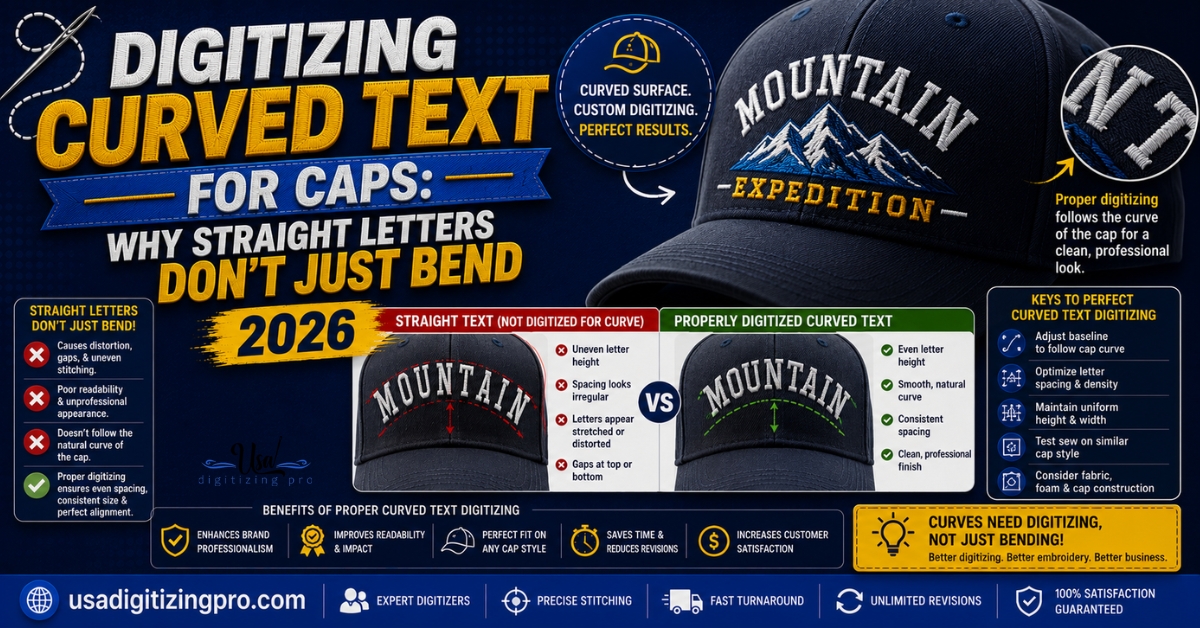
Digitizing Curved Text for Caps: Why Straight Letters.
Text that reads perfectly straight on a screen doesn't automatically curve cleanly once it's stitched across a cap front. Digitizing curved text.