

Left Chest Digitizing for Polo vs Button Up Shirts: What Actually Changes 2026
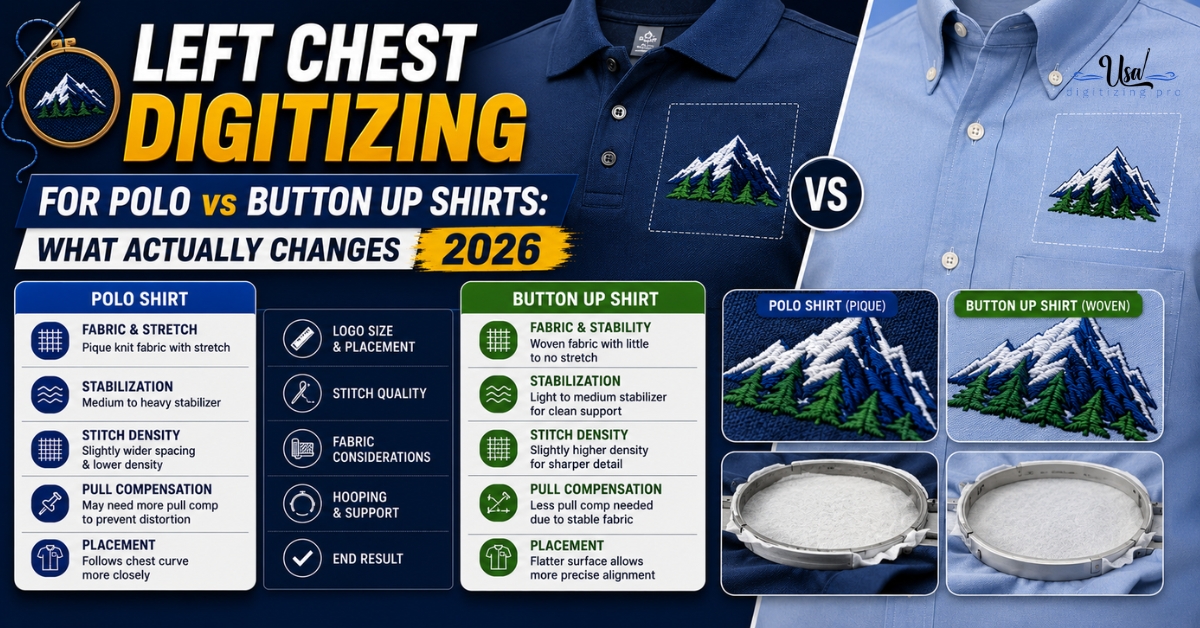
Order the same left chest logo for a batch of polos and a batch of button-up dress shirts, and you might expect one file to cover both. Left chest digitizing for polo vs button up shirts actually shares more placement math than most buyers expect, but the fabric underneath the stitching, and whether a pocket is in the way, changes enough that treating the two as identical can produce a logo that sits slightly off on one garment type. Here’s where the two actually align and where they don’t.
Quick Answer at a Glance
Why the Placement Math Is Nearly Identical
Both polos and button-up dress shirts, without a chest pocket, use essentially the same left chest placement reference: roughly 7 to 9 inches down from the shoulder seam, centered between the placket and the side seam, or about 4 to 6 inches to the right of the placket. The shoulder seam is the anchor point in both cases, since collar style and shirt cut vary more than the shoulder seam’s position does. This is the part of left chest placement that genuinely doesn’t change much between the two garment types.
Where the Two Diverge: Fabric Behavior
Polos are knit garments, which stretch in ways a woven button-up shirt’s fabric doesn’t. That stretch affects how the embroidery sits once the hoop tension releases, and it’s the main reason knit garments need proper stabilizer and, in some cases, slightly adjusted density compared to a woven shirt. Button-up dress shirts, being a tighter, more stable weave, generally hold embroidery tension more predictably, which is part of why corporate embroidery on woven shirts often looks marginally crisper than the same design on a polo. For more on how digitizing decisions get made per garment during the design audit stage, the embroidery file format guide covers the broader set of format and machine considerations that come into play once a file is finalized.
The Pocket Problem: Where Button-Up Shirts Genuinely Differ
Here’s the real divergence point most placement guides gloss over. A button-up dress shirt with a chest pocket changes the placement rule entirely: the logo needs to center on or above the pocket rather than following the standard 7 to 9 inch measurement, since stitching directly across a pocket opening causes puckering and structural problems. Polos essentially never have a chest pocket, so this consideration simply doesn’t apply to them. Any left chest order spanning both garment types needs to account for pocket presence as a button-up-specific variable.
Side-by-Side: Polo vs Button-Up Left Chest Digitizing
Why a Single File Usually Works, With Small Adjustments
The design itself, the artwork and its digitized stitch path, typically transfers across both garment types without a full rebuild, since the placement math and size are the same. What sometimes needs adjusting is density and underlay: a polo’s knit stretch benefits from slightly different stabilization than a stable woven shirt does. A good digitizer will flag this during the order rather than silently applying identical settings to both fabric types and hoping for the best.
What Happens If the Pocket Rule Gets Missed
Stitching a standard 7 to 9 inch placement directly across a chest pocket opening on a button-up shirt causes the pocket to pucker or distort, since the stitching and the pocket’s own seam construction fight each other in that space. This is an easy mistake to make when an order form doesn’t specifically ask whether the button-up shirts in the batch have a pocket, which is exactly why that question should come up before digitizing rather than after a batch comes back with a distorted pocket.
Pre-Order Checklist for a Mixed Polo and Button-Up Order
- Confirm the shoulder-seam placement measurement applies the same way across both garment styles in your order.
- Ask specifically whether the button-up shirts have a chest pocket, and if so, plan for pocket-centered placement instead.
- Flag the fabric type (knit polo vs woven shirt) so density and stabilizer choices are matched correctly.
- Request a sample from each garment type rather than assuming one sample covers both.
- Confirm the finished size works visually on both garment styles, since a size that reads well on a polo may sit differently on a more structured dress shirt.
A Real Order, Broken Down
A property management company in Arizona ordered matching left chest logos for a mixed batch of 40 polos and 25 button-up shirts, unaware that half the button-up shirts had a chest pocket and half didn’t. The initial order form only specified one placement measurement for the whole batch.
Once the digitizer flagged the pocket inconsistency, the order was split: pocket-style shirts got the logo centered above the pocket, while non-pocket shirts and all the polos used the standard 7 to 9 inch measurement. The company confirmed this matched what their previous vendor had missed on an earlier order, where several pocket shirts came back with visibly puckered stitching directly through the pocket opening.
Who Builds These Files
USA Digitizing Pro has digitized left chest logos for both polos and button-up shirts from its Texas studio since 2015, adjusting for pocket presence and fabric type on every order rather than applying one generic setting across garment types. Standard turnaround runs 2 to 4 hours, with pricing starting at $15 for designs under 5 inches. Every file carries a money-back quality guarantee.
Frequently Asked Questions
Largely yes, both use roughly 7 to 9 inches down from the shoulder seam as the standard reference. The main difference comes into play only if the button-up shirt has a chest pocket, which changes the placement rule.
Stitching directly across a pocket opening at the standard placement measurement causes puckering and structural distortion, since the embroidery and the pocket’s own seam construction interfere with each other. Centering above or on the pocket avoids this.
Generally yes. Polo knit fabric stretches more than a woven button-up shirt, so it typically needs cut-away stabilizer to hold the embroidery’s shape properly, while a stable woven shirt often needs less aggressive stabilization.
Usually, with minor density or underlay adjustments for the fabric difference. The core design and placement typically transfer cleanly, but a good digitizer will review both fabric types rather than assuming identical settings work for each.
Knit fabric’s natural stretch makes it more prone to distortion under embroidery tension than a stable woven shirt. Correct stabilizer and appropriately adjusted density reduce this risk significantly.
The same standard 3 to 4 inch left chest range generally works well on both, since neither garment type changes the fundamental sizing guidance. Fine text may need slightly more care on a polo due to the knit’s texture.
Not significantly, since the shoulder seam serves as the fixed anchor point regardless of collar style. Collars vary in cut and position more than shoulder seams do, which is why placement math anchors to the seam rather than the collar.
This needs to be flagged clearly in the order, since pocket and non-pocket units in the same batch require different placement approaches. Splitting the order into two placement groups is the standard way to handle this.
Woven button-up shirts tend to hold embroidery tension more predictably due to their stable weave, while polos require more careful stabilizer selection due to their knit stretch. Neither is inherently harder, but they need different handling.
Not meaningfully. Turnaround is driven more by design complexity and order volume than by which of these two garment types the design is being stitched onto.
Ordering Across Both Garment Types Correctly
Left chest digitizing for polo vs button up shirts shares the same core placement math, but fabric type and pocket presence are the two variables that actually require separate handling. Flag both before you order, and the same logo transfers cleanly across a mixed batch without surprises. USA Digitizing Pro checks both fabric type and pocket presence on every order, starting at $15 for designs under 5 inches, with a 2 to 4 hour turnaround.

RELATED BLOGS

Hat Machine Embroidery Services: What Drives the Price.
Published September 21, 2026 | By USA Digitizing Pro Team Quotes from hat machine embroidery services look inconsistent until you understand what.

Left Chest Embroidery Problems: Placement Fixes That Work.
Published August 17, 2026 | By USA Digitizing Pro Team A left chest logo that sits crooked, rides too high or lands.