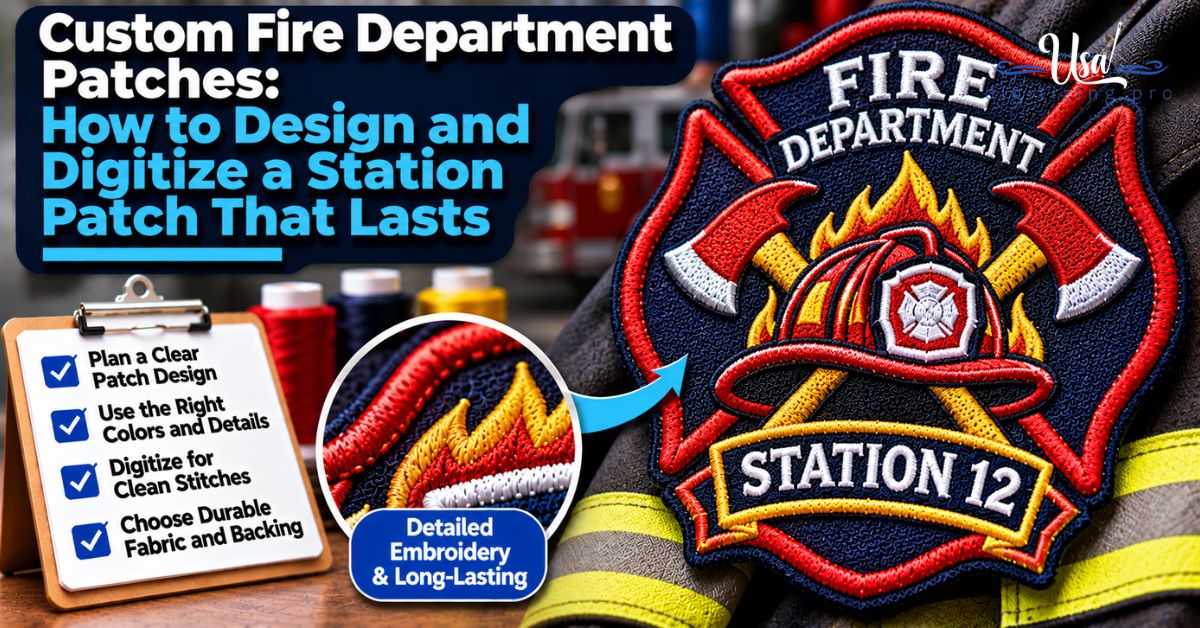
Custom Fire Department Patches: How to Design and Digitize a Station Patch That Lasts
By USA Digitizing Pro Team | Published November 2026 | Updated November 2026
There’s a lot of pride packed into a fire department patch. The station number. The department name. The Maltese cross. Often the year the company was founded. It goes on duty shirts, jackets, hats and gear bags. Getting all of it into a few inches of thread takes planning. Custom fire department patches look best when the cross stays crisp, the text stays readable and the colors stay bold. This post covers the design rules, what the stitch file needs and how to order. Every file from our patch digitizing services is built by hand.
Quick Answer
Custom fire department patches work best with a clean Maltese cross, bold station or department text, a small color palette and a merrowed or satin border. The digitizer simplifies fine tools and details, keeps letters at about 4mm or taller and builds firm underlay on twill so the patch stays flat.
| Element | Best approach | Watch out for |
|---|---|---|
| Maltese cross | Bold satin edges, clean points | Thin points that fray |
| Station number | Large, bold numbers | Small numbers crowded by tools |
| Department name | Satin text on an arc | Letters under about 4mm |
| Tools and trucks | Simplified shapes | Fine ladder rungs and hose lines |
| Founded year | Keep large or move to border | Tiny text that closes up |
| Colors | Red, gold, black, white and a few more | Too many shades |
Ordering for your station? Send the design and size to art@usadigitizingpro.com. Standard files are back in 2 to 4 hours.
What Goes on a Fire Department Patch?
An emblem, a name and a number, in most cases. Plenty of departments add a founding year, a motto or a city name too. The Maltese cross is by far the most common emblem. Others go with a helmet front, crossed axes, ladders, a truck or a local landmark. The layout usually puts the name in an arc at the top. The emblem sits in the center, with the city or year closing out the bottom.
How Do You Keep the Maltese Cross Clean?
Bold satin edges. Slightly rounded tips. A solid fill in the center.
Sharp, narrow points are where thread fails first. Satin can’t cover a very fine point, which is why each tip is shaped so the stitches can wrap it fully. The center circle or shield usually holds the station number or initials. Keep that inner area big enough for text people can actually read.
How Should Text and Numbers Be Built?
Bold satin for names and numbers, at about 4mm tall or more. Big station numbers are often the strongest part of the whole design. Arc text needs careful spacing. Letters bunch up on the inside of the curve. Trying to fit both the founding year and a motto? Decide which matters more and size that one up. Small text is the first thing to blur after many washes.
How Do You Handle Detailed Tools and Trucks?
Turn them into bold shapes. Ladder rungs, hose lines and truck details look sharp in print. In thread at patch size, they merge. Keep the outline people recognize. Remove the extra lines. A ladder might become a few thick rungs instead of a dozen thin ones. A truck might lose its small windows and lights. The simplified proof should be approved before production. That way the department signs off on the look.
Which Colors Work Best?
A short list of solid colors. Red, gold, black and white are the classics, with blue or silver for some departments. Flames with lots of shading become two or three solid flame colors. Metallic gold thread is popular for borders and lettering. It’s harder to sew than standard thread, though (ask your producer whether they run it). Send Pantone references if your department has them.
Which Border and Backing Should You Choose?
Merrowed for round and shield shapes. Satin or hot cut for custom outlines. Merrowed edges need a clear margin of about 3 to 4mm between the design and the edge. Twill backing holds detail well. Duty shirts usually get sew-on patches. Gear bags and tactical vests often use hook-and-loop instead, as explained in custom Velcro patch digitizing. Edge choices are compared in patch digitizing border types.
What Does the Stitch File Need?
Firm underlay on twill. Controlled density in the big red fills. Clean satin for the cross and the text. Large red areas pull the backing, especially when the cross fills most of the patch. Underlay and pull compensation keep the cross straight and lined up with its outline. The order runs background first, then the cross, then numbers and text, with the border last.
Here’s a common one. A volunteer company sends a patch with a Maltese cross, a ladder truck inside it, the station number and “EST. 1952” in tiny letters. The truck gets swapped for a bolder helmet shape. The station number is enlarged in the center of the cross. The year moves into the bottom arc, where it fits at a readable size. The chief approves the proof before the file is finalized.
What Should You Send With the Order?
| 1 | Clear artwork, ideally vector, plus any old patch for reference. |
| 2 | Patch size and shape. |
| 3 | Thread colors or Pantone references. |
| 4 | Border type and backing. |
| 5 | Text that must appear, in order of importance. |
| 6 | Your machine format or your producer’s format. |
Are Other Uniform Patches Built the Same Way?
Mostly, yes. Police, EMS and military patches share the same readability rules. Related setups are in custom law enforcement patches, custom military patch designs and custom name patches.
About the Author
USA Digitizing Pro Team. Patch files have been built by hand here since 2015 for US departments, uniform suppliers and patch makers. Clean emblems and readable text come first.
Frequently Asked Questions
It’s the traditional US firefighter emblem, standing for protection and service.
The department’s uniform policy sets the size; confirm it before the file is built.
Yes, metallic gold and silver are popular, though they sew slower and need lighter density.
Get the design, size, colors and quantity approved, then send them for digitizing and production.
Sew-on for duty uniforms and turnout jackets, iron-on only for casual items like hats and bags.
Yes, with bold stripes and fewer, larger stars so it stays readable at patch size.
Custom fire department patches look best with a clean Maltese cross, bold numbers, simplified tools and a strong border. Send your approved design to USA Digitizing Pro. Standard files arrive in 2 to 4 hours. Order your fire patch file.
Follow Us

RELATED BLOGS
Left vs Right Sleeve Embroidery: Industry Placement Rules.
Published August 17, 2026 | By USA Digitizing Pro Team Ask three uniform buyers which sleeve the logo goes on and you'll.
Silhouette Art Digitizing for Pet Portraits: Turning a.
A pet photo has fur texture, shadow, and a busy background. A silhouette has none of that on purpose. Silhouette art digitizing.