
Silhouette Art Digitizing for Pet Portraits: Turning a Photo Into a Clean Shape 2026
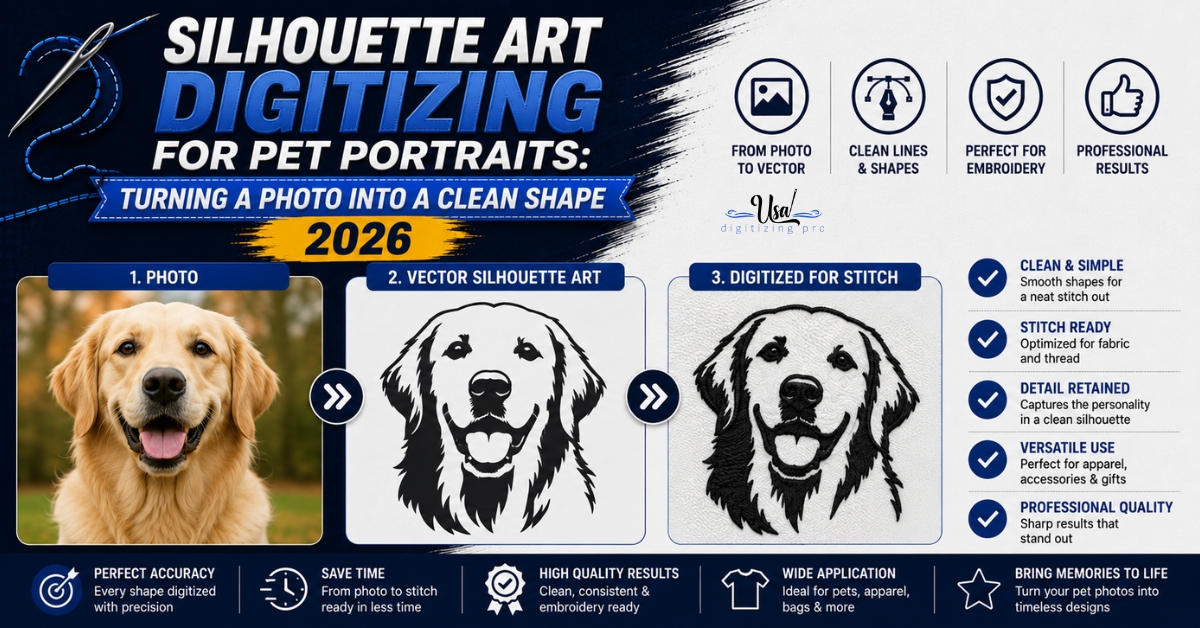
A pet photo has fur texture, shadow, and a busy background. A silhouette has none of that on purpose. Silhouette art digitizing for pet portraits takes a photo of a dog, cat, or other pet and reduces it to a single, clean solid shape, the kind that reads instantly on a tote bag, a hoodie, or a stitched patch from across a room. Getting there isn’t a one-click filter. It’s a deliberate editing process that decides which details to keep and which ones would just turn into noise once the shape is small and flat.
Quick Answer at a Glance
What Silhouette Art Digitizing Actually Is
Silhouette art digitizing: converting a photo into a single flat-color shape that captures only the outer outline of the subject, with no internal detail, shading, or texture. For a pet portrait, this means the final art shows the dog or cat’s outline: ears, tail, posture, and general body shape, filled solid in one color. Everything inside that outline, fur pattern, eye detail, coat markings, gets dropped entirely. The goal is a shape that reads clearly and instantly, the same way a stop sign or a logo does, rather than trying to preserve photographic detail. This is a different process than standard JPG to vector conversion, which traces multi-color artwork rather than reducing a photo to one solid shape.
Why Pet Photos Need Careful Editing, Not Just Tracing
Running a pet photo through an automatic background-removal or auto-trace tool usually produces a rough, jagged outline that looks nothing like a clean silhouette. Fur edges are the main problem. A dog’s coat doesn’t have one clean line separating it from the background the way a logo’s hard edges do. An artist working the photo by hand has to make a judgment call about where the outline should sit: tight against the visible fur edge, or smoothed slightly to avoid a spiky, uneven silhouette that reads as messy rather than clean.
Which Pet Photos Work Best for Silhouette Art
Side Profile Shots
A clean side profile, showing the full body outline from nose to tail, translates into the most recognizable and visually strong silhouette. Ear shape, tail curve, and posture all read clearly from this angle.
Sitting or Standing Poses with a Clear Outline
Poses where the pet’s legs and body don’t overlap confusingly work better than a curled-up or crouched pose where the outline becomes ambiguous. A simple, upright stance gives the cleanest final shape.
Photos with Good Contrast Against the Background
A pet photographed against a plain, contrasting background is far easier to trace accurately than one shot against a busy or similarly colored backdrop, since the artist can see exactly where the outline should fall.
Breeds and Poses That Need Extra Simplification
Long-haired and fluffy breeds present the biggest challenge, since the fur edge blends gradually into the background rather than forming one clean line. For these, an artist typically smooths the outline into a slightly simplified shape that still reads as the correct breed silhouette without trying to capture every stray hair. Curled or overlapping poses, like a cat mid-stretch or a dog turning its head sharply, also need editorial judgment calls about which parts of the outline to simplify so the final shape doesn’t turn into a confusing blob.
Silhouette Art vs Detailed Pet Portrait Embroidery: Which One Fits Your Project
Why Simpler Sometimes Reads Better Than Detailed
Here’s something most pet portrait sellers don’t emphasize. A detailed, photo-realistic embroidered portrait is impressive up close, but a bold, well-cut silhouette often communicates the pet’s identity faster from across a room. On a small item like a tote bag corner or a patch, the detailed approach frequently loses legibility entirely, while a silhouette stays recognizable even at 2 inches. For gift items meant to be seen at a glance rather than studied closely, silhouette art is frequently the stronger practical choice, not just the cheaper one.
Turning Silhouette Art Into an Embroidered File
Once the silhouette shape is finalized as clean vector art, it converts into an embroidery stitch file using standard fill or satin stitching in a single thread color. Since there’s no internal color separation or shading to manage, this step is generally faster and lower in stitch count than a multi-color detailed portrait would be, which keeps both cost and turnaround down for buyers who want the piece stitched rather than printed.
What You’re Actually Paying For
- A hand-edited outline built from your specific pet photo, not an automated filter
- Judgment calls on fur edges, overlapping poses, and background separation
- Vector delivery in AI, EPS, PDF, and SVG for any downstream use
- A ready-to-stitch file if embroidery is the intended output
- Free revisions if the outline doesn’t capture the pet’s recognizable shape on the first pass
Preparing Your Pet Photo Before You Order
- Choose a side profile or clear standing pose whenever possible.
- Pick a photo with good contrast between the pet and the background.
- Avoid photos where the pet’s legs or tail overlap confusingly with its own body.
- Note the intended end use (embroidery, print, sticker) so the artist optimizes the outline for that output.
- Mention any distinctive feature (a curled tail, floppy ears, a specific stance) you want preserved if the pose is ambiguous.
A Real Order, Broken Down
A pet gift shop owner in Portland ordered silhouette art for a client’s long-haired Pomeranian, submitted from a photo taken at an angle with the dog mid-stride. The fur made the natural outline extremely irregular, and the walking pose put the front legs overlapping visually with the body.
The artist worked from a second reference photo the client provided showing a cleaner standing pose, and smoothed the fur edge into a simplified but still recognizably fluffy silhouette rather than trying to trace every strand. The finished shape was digitized into a single-color embroidery file and stitched onto a set of tote bags for a holiday gift order. The client confirmed the silhouette was instantly recognizable as their specific dog despite the simplification.
Who Builds These Files
USA Digitizing Pro has produced silhouette art and vector conversions from its Texas studio since 2015. Every silhouette is hand-edited from the actual submitted photo rather than run through an automated filter. The team backs its work with a money-back quality guarantee.
Frequently Asked Questions
Most can, though photos with a clear pose and good background contrast produce the cleanest results fastest. Blurry, low-resolution, or heavily backlit photos may need a better reference image before an accurate silhouette can be built.
A regular portrait tries to reproduce the pet’s coloring, fur texture, and shading using multiple thread colors. Silhouette art drops all of that in favor of one solid-color outline shape, which reads faster at a distance and works well on smaller items.
Yes. The same principles apply: a clear profile or standing pose with visible ears, tail, and body shape translates cleanly, while curled or crouched poses need more editorial simplification.
Sometimes, but it may need extra simplification or a second reference photo to fill in details the original angle doesn’t show clearly. A three-quarter angle or a photo with overlapping limbs is harder to convert accurately than a clean profile shot.
Standard delivery includes AI, EPS, PDF, and SVG vector formats. If the silhouette is headed for embroidery, a stitch file in your required machine format (DST, PES, JEF, and others) is also included.
Yes. Since it’s delivered as vector artwork, the same file works for screen printing, vinyl cutting, laser engraving, or any other production method that benefits from a clean single-color vector shape.
Simple, clear photos typically turn around in a few hours. Complex poses or fluffy breeds needing extra simplification may take longer, since the outline requires more manual editorial judgment.
It will capture the recognizable shape and posture rather than exact fur detail. Most owners find the silhouette instantly recognizable as their specific pet based on ear shape, body proportions, and pose, even without internal detail.
Yes. Revisions are available if the outline doesn’t capture the pet’s shape accurately, particularly for ambiguous poses where the artist may need guidance on which details matter most to preserve.
Generally, since it involves one color and no shading work, silhouette art requires less production time than a multi-color detailed portrait, which typically brings the cost down as well.
Getting Your Pet’s Silhouette Right
Silhouette art digitizing for pet portraits works best when it starts from a clear, well-posed photo and gets edited by hand rather than run through an automatic filter. A clean outline reads instantly on a bag, a shirt, or a patch in a way detailed portraits sometimes can’t at small sizes. USA Digitizing Pro hand-edits every silhouette from the actual submitted photo, backed by a money-back quality guarantee.
Follow Us

RELATED BLOGS

Applique Digitizing Stitch Count Reduction: Techniques That Work.
Published August 17, 2026 | By USA Digitizing Pro Team Switching a large design from full embroidery to applique cuts stitch count.

Custom Embroidery Design Services: How to Vet a.
Published September 16, 2026 | By USA Digitizing Pro Team Every provider of custom embroidery design services says the same things on.