
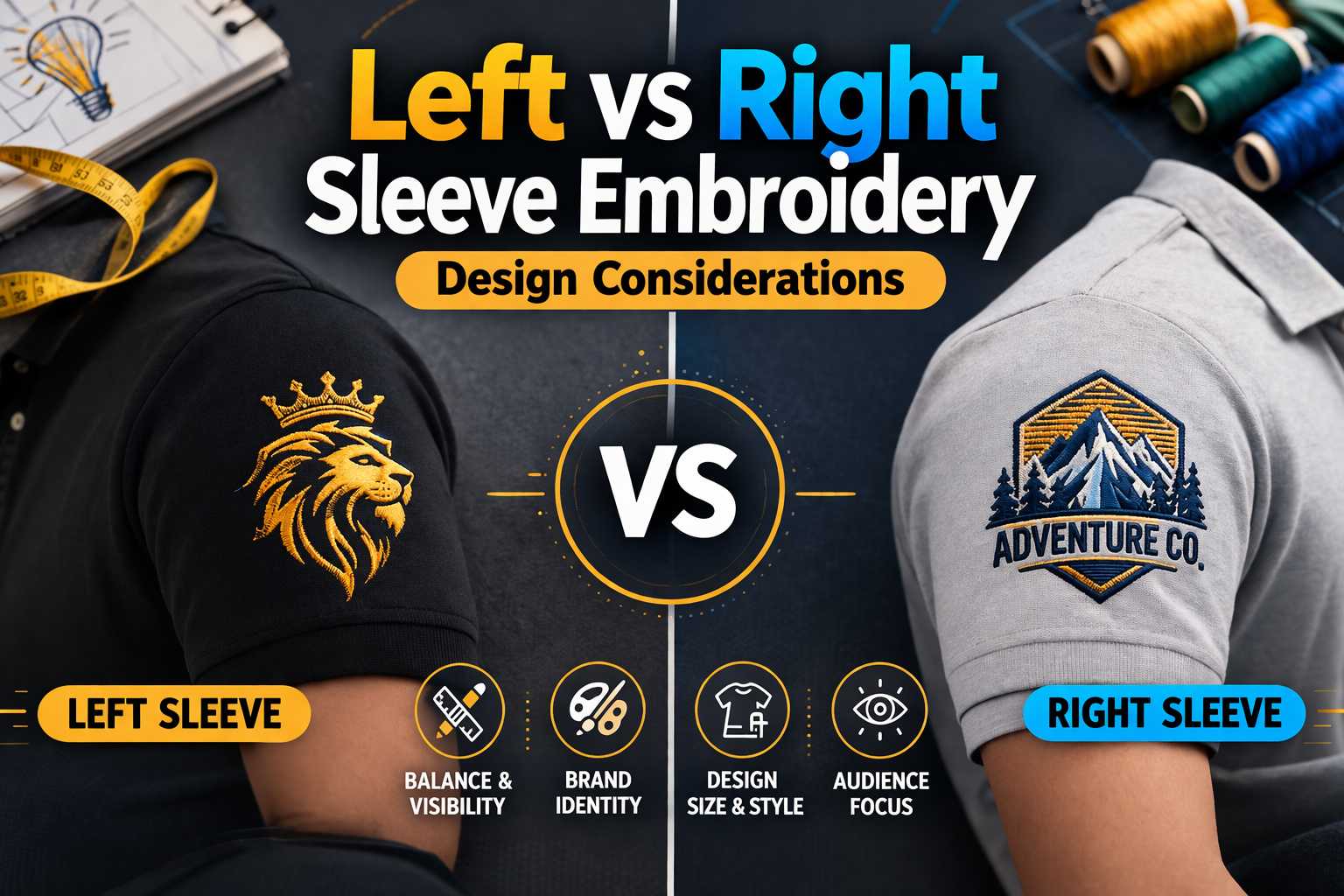
Left vs Right Sleeve Embroidery: Industry Placement Rules 2026
Published August 17, 2026 | By USA Digitizing Pro Team
Ask three uniform buyers which sleeve the logo goes on and you’ll get three confident answers. Left vs right sleeve embroidery follows real conventions, but those conventions shift depending on the industry the garment is built for. A sports jersey handles the two sleeves differently from a work jacket and a service uniform follows rules neither of those does. Knowing the convention for your specific sector prevents an order that looks slightly off to everyone who works in that field.
Quick Answer at a Glance
| Question | Answer |
|---|---|
| Which sleeve is the default for a company logo? | Left upper sleeve, the industry standard across most programs |
| What goes on the right sleeve? | Secondary marks: player numbers, season years, division names, co brand logos |
| Standard upper sleeve logo size? | 2 to 4 inches wide |
| How far below the shoulder seam? | Typically 1 to 2 inches below the seam, centered on the upper arm |
| Cuff logo size? | Typically 1 to 3 inches |
| Do both sleeves need separate files? | Yes, each sleeve is digitized and positioned independently |
| What does sleeve digitizing cost? | Starting at $15 for designs under 5 inches, $25 above 5 inches, 2 to 4 hour turnaround |
Why the Left Sleeve Became the Default
The left sleeve carries the primary brand mark across most programs for a practical reason: when someone faces the wearer, the left sleeve sits forward in the viewer’s line of sight and reads first. That visibility advantage is why company logos, team crests and organizational identifiers default there. Standard placement centers the mark on the upper arm, roughly 1 to 2 inches below the shoulder seam. For the file requirements behind either placement, the sleeve embroidery digitizing overview covers pull compensation and sizing for the curved sleeve surface.
Sports Jerseys: Crest Left, Number Right
Team programs follow the clearest convention of any sector. The team crest or club mark sits on the left upper sleeve, while the player number runs on the right. Numbers are typically fill stitched at 2 to 4 inches tall and the challenge in the file is keeping fill density consistent across large single color numeral blocks so the finished number doesn’t look mottled. Reversing these two placements reads immediately wrong to anyone familiar with team apparel.
Workwear and Trade Uniforms: Company Left, Division Right
Work jackets and trade uniforms put the company logo on the left sleeve and use the right for division identifiers, certifications or crew designations. A plumbing contractor might carry the company mark left and a licensing or certification badge right. This split lets a single garment identify both the employer and the specific role or qualification without crowding either mark.
Corporate and Hospitality: Often Left Only
Corporate polos and hospitality uniforms frequently use just one sleeve and it’s almost always the left. A single clean logo on the left upper sleeve paired with a left chest mark reads as polished rather than busy. Adding a right sleeve element to a corporate polo tends to push the garment toward looking like team apparel rather than professional attire, which is usually the opposite of the intended effect.
Military, Fire and Service Uniforms: Rank and Unit Conventions
Service uniforms follow the strictest conventions of any category and they often differ from commercial standards entirely. Unit patches, rank insignia and flag placements have specified sides and positions that come from organizational regulation rather than branding preference. Anyone digitizing for this sector should work from the specific organization’s published placement requirements rather than assuming the general left primary rule applies.
Varsity and Letterman Jackets: A Different Logic
Varsity jackets break the standard pattern because the sleeves themselves carry meaning. Award patches, year numerals and activity emblems often run down the sleeves in a sequence rather than sitting as a single logo placement. Leather sleeves also demand lower stitch density than fabric, since needle holes in leather don’t close after sewing, making test stitching essential before any full run.
Side by Side: Which Sleeve by Industry
| Industry | Left Sleeve | Right Sleeve |
|---|---|---|
| Sports teams | Team crest or club mark | Player number |
| Workwear and trades | Company logo | Division, crew or certification mark |
| Corporate and hospitality | Company logo | Usually left blank |
| Military and service | Per organizational regulation | Per organizational regulation |
| Varsity and letterman | Award patches or year numerals | Activity emblems or secondary awards |
Why Both Sleeves Need Separate Files
A program running marks on both arms can’t reuse one file flipped. Each sleeve is digitized and positioned independently, since the two designs are usually different elements at different sizes and the centering reference differs between arms. Even when the same logo appears on both sleeves, each placement gets its own file so the positioning and pull compensation stay accurate for that specific arm.
The Hooping Mistake That Ruins Correct Placement
A file can be positioned perfectly and still stitch out off center if the production team hoops to the wrong reference point. The most common error is centering the tubular hoop on the sleeve seam instead of on the center of the flat panel, which are two different points on most garments. Confirming this reference with the production floor matters as much as getting the placement right in the file.
Planning a Two Sleeve Program
- Identify your industry’s convention before deciding which mark goes where.
- Confirm the primary brand mark goes left unless your sector specifies otherwise.
- Assign secondary elements, numbers, years or division marks, to the right sleeve.
- Order separate files for each sleeve rather than assuming one file can be mirrored.
- Brief the full garment program at once, chest and both sleeves, so settings stay consistent across placements.
A Real Order, Broken Down
A Texas electrical contractor ordered branded work jackets for a twelve person crew. The company logo went on the left upper sleeve at 3 inches wide, positioned about an inch and a half below the shoulder seam following the standard workwear convention.
The right sleeve carried a smaller state licensing designation, giving inspectors and clients a visible credential without crowding the company mark. Both sleeves were digitized as separate files with pull compensation set for the jacket sleeve diameter and a cutaway backing was specified since the heavy woven shell needed more stabilization than a tear away could provide.
Who Builds These Files
USA Digitizing Pro has built sleeve stitch files for sports brands, workwear programs and apparel decorators across the United States since 2015, with every file hand built from its Texas studio. Pricing starts at $15 for designs under 5 inches and $25 above 5 inches, with a 2 to 4 hour turnaround and a money back quality guarantee.
Frequently Asked Questions
The left upper sleeve is the standard across most programs, since it sits forward in a viewer’s line of sight and reads first when someone faces the wearer.
Typically 2 to 4 inches wide for upper sleeve placement, with cuff logos usually running smaller at 1 to 3 inches.
Standard placement centers the design on the upper arm about 1 to 2 inches below the shoulder seam.
The underlying logic is the same, primary mark left and secondary right, but the specific elements differ. Jerseys put the crest left and the player number right, while workwear puts the company logo left and division or certification marks right.
No. Each sleeve is digitized and positioned independently, since the designs, sizes and centering references usually differ between the two arms.
The most common cause is hooping to the sleeve seam instead of the center of the flat panel, which are different points on most garments.
Not necessarily. Service uniforms follow organizational regulations for rank, unit and flag placement, so those published requirements take priority over general commercial conventions.
Leather needs lower stitch density than fabric, since needle holes don’t close after sewing. Test stitching before a full production run is essential on leather sleeves.
Usually not. A single left sleeve mark paired with a left chest logo reads more professional, while adding a right sleeve element tends to make the garment look like team apparel.
Pricing starts at $15 for designs under 5 inches and $25 for designs above 5 inches, with a standard 2 to 4 hour turnaround.
Getting the Side Right for Your Sector
Left vs right sleeve embroidery follows a general rule, primary mark left and secondary right, but the specifics shift by industry. Sports puts the crest left and the number right. Workwear splits company logo and certification. Corporate often uses left only. Service uniforms follow their own regulations entirely. Matching your sector’s convention is what makes a uniform look intentional. USA Digitizing Pro builds sleeve files for all of these programs.
Follow Us

RELATED BLOGS
Custom Embroidery Digitizing Services for Individual Designs: The.
Published October 16, 2026 | By USA Digitizing Pro Team Custom embroidery digitizing services for individual designs are priced the same way.

Logo Digitizing for Small Businesses: 2026 Pricing Guide
A small business ordering its first embroidered logo usually has one question before anything else: what does this actually cost. Logo digitizing.