

Applique Digitizing Services
What Is Applique Digitizing? Clean Stitch Files for Every Fabric Type
Applique embroidery combines fabric and thread in a way that flat digitizing never matches for large bold designs. A solid filled letter at 8 inches tall would take tens of thousands of stitches as standard fill embroidery. As an applique it uses a fraction of the thread, finishes faster on the machine and sits flatter on the garment. The challenge is that applique digitizing is more technically demanding than standard logo digitizing.
Three separate stitch layers must be sequenced correctly, timed with manual fabric placement and trimming between machine stops and finished with a satin border that encases the fabric edge cleanly. Get any one of those stages wrong and the result shows on every garment in the run.
USA Digitizing Pro builds applique digitizing files from its Texas studio for embroidery shops, varsity jacket producers, sports apparel suppliers and promotional product decorators across the United States. Every file is built by a human digitizer with correct placement, tack down and cover stitch sequencing matched to the fabric type and garment you're running. Designs under 5 inches start at $15. Turnaround runs as fast as 2 to 4 hours. Rush service is free for first time customers.
Quick Answer
| Detail | Value |
|---|---|
| Starting price | $15 flat for designs under 5 inches |
| Complex artwork | Quoted above $25 before work begins |
| Turnaround | 2 to 4 hours for standard designs |
| Same day delivery | Orders received before 3 PM CT |
| Rush service | Free for first time customers |
| File formats | DST, PES, EMB, JEF, VP3, EXP, HUS, XXX |
| Fabric types covered | Cotton, felt, twill, fleece, denim, performance knit |
| Applique styles | Satin covered, raw edge, tackle twill, hybrid applique with fill |
| Guarantee | Unconditional money back if stitched sample doesn't match preview |
What Is Applique Digitizing

Applique is the technique of attaching a fabric piece to a base garment and securing its edges with stitching. In machine embroidery, the process requires three distinct stitch layers built in a specific sequence and separated by machine stops for manual work. Applique digitizing is the process of building that stitch file so each layer triggers at the right moment, in the right position, with the correct stitch type for the fabric involved.
The finished result is a design where fabric fills the main shape and thread covers the edges. The fabric provides the color and texture. The thread border holds the fabric in place permanently and gives the design a clean finished edge. Large shapes, bold letters and geometric fills all produce better results as applique than as solid fill embroidery because the thread count stays low and the design sits flat against the garment surface.
Applique vs Standard Fill Embroidery
Standard fill embroidery covers every square millimeter of a shape with thread. A 6 inch letter built entirely in fill stitch can run 20,000 stitches or more. That stitch volume adds weight, stiffness and production time to every garment in the run. The same letter as an applique runs a placement stitch, a tack down stitch and a satin border. Total stitch count drops to under 4,000. The letter lies flat, weighs almost nothing and finishes in a fraction of the machine time. For large scale designs on jerseys, jackets and outerwear, applique is the production smart choice.
The Three Stitch Layers Every Applique File Needs
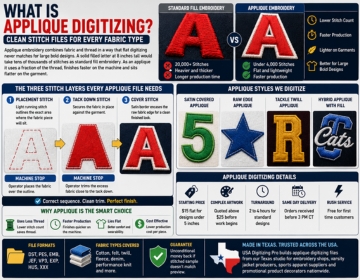
A correctly built applique file contains three distinct stitch objects in sequence. Each one serves a specific function. Skipping or misbuilding any layer produces failures that show on the garment and cannot be corrected after production.
The Placement Stitch
The placement stitch is a light running stitch that outlines the exact area where the fabric piece will sit. The machine stitches this layer and stops. The operator lays the applique fabric over the outline, aligns it to the shape and signals the machine to continue. This stitch has to be precise. If the outline drifts from the intended shape, every piece of fabric placed on it for the entire run will drift by the same amount.
The Tack Down Stitch
The tack down stitch runs over the fabric after it has been placed, securing it against the base garment. The machine stops again after this layer. The operator trims the excess fabric as close to the tack down line as possible before the final stitch layer runs. The tack down needs to hold the fabric firmly enough that trimming scissors can work cleanly without shifting the piece. Too light and the fabric moves under the scissors. Too dense and it perforates the fabric and leaves marks on the finished garment.
The Cover Stitch
The cover stitch is the satin border that encases the raw fabric edge after trimming. It runs slightly wider than the tack down line on both sides so it covers the cut fabric edge completely. A gap between the satin border and the fabric edge allows fraying to start. An overly dense satin border creates a stiff ridge that pulls the base garment and puckers the surrounding fabric. Getting the cover stitch width, density and pull compensation right is the step that separates professional applique files from files that look acceptable in a preview but fail on the garment.
Applique Styles We Digitize
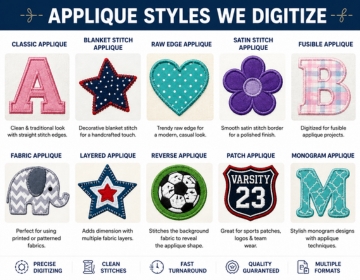
Satin Covered Applique
Satin covered applique is the standard for US commercial apparel work. A tight satin column runs around the entire perimeter of the fabric piece, encasing the raw edge and giving the design a clean raised border. This is the style used for varsity letters, team logos, school emblems and most corporate branded apparel where a polished finished edge is expected.
Raw Edge Applique
Raw edge applique intentionally leaves the fabric edge unsealed after the tack down. The fraying edge becomes part of the design aesthetic, popular in contemporary streetwear, denim applications and decorative home textiles. The digitizing for raw edge applique still requires a precise placement and tack down sequence. The cover stitch is either omitted entirely or replaced with a light decorative running stitch that holds the fabric without encasing the edge.
Tackle Twill Applique
Tackle twill is a woven polyester fabric cut into letters and numbers and applied to jerseys and uniforms. It's the standard material for athletic numbers, player names and team lettering on US sports uniforms. Tackle twill applique digitizing accounts for the stiffness of the material, the heat seal adhesive backing most twill letters carry and the requirement for a satin border that sits flat against the knit jersey fabric without pulling.
Hybrid Applique with Embroidered Detail
Hybrid applique places fabric as the base layer and adds embroidered elements on top of the fabric surface. A team mascot might use felt as the body fill with satin stitch detail work stitched directly onto the felt surface. This approach gives the finished design a layered three dimensional quality that neither pure embroidery nor plain applique achieves alone. The digitizing for hybrid work is more complex because the stitch sequence must correctly layer the fabric placement, tack down, embroidered details and final border in the right order for the machine to run cleanly.
Fabrics That Work Best for Applique
| Fabric | Behavior | Best Applique Style | Notes |
|---|---|---|---|
| Cotton twill | Stable, minimal stretch | Satin covered, tackle twill | Standard for lettering and logos |
| Felt | No fraying, holds shape | Satin covered or raw edge | Great for mascots and large fills |
| Fleece | Stretchy, needs stabilizer | Satin covered | Lower density to prevent pull |
| Denim | Heavy, stiff | Raw edge or satin covered | Use heavy needle, reduce speed |
| Performance knit | Stretch fabric | Satin covered | Cut away stabilizer required |
| Woven polyester (twill) | Firm, minimal fray | Tackle twill standard | Common for jerseys and uniforms |
What Bad Applique Digitizing Looks Like
Fabric lifting at the edges is the most common applique failure. The satin border doesn't fully cover the trimmed fabric edge. Thread shrinks slightly under tension and pulls the border away from the edge by a fraction of a millimeter. On a light colored applique fabric over a dark garment, that gap is visible on every finished garment. The fix is pull compensation applied to the cover stitch during digitizing, not a machine adjustment at the press.
Fabric shifting between placement and tack down produces a design where the fabric piece sits slightly outside the placement outline. The satin border then covers the intended edge but leaves a strip of base garment visible between the fabric and the border on one side. This happens when the tack down layer doesn't adequately hold the fabric before the machine stops for trimming. The operator moves the fabric during trimming and the piece shifts.
Puckering around the satin border appears when the cover stitch density is too high for the base garment fabric. Dense satin stitches pull the surrounding fabric inward. On lightweight knits and performance fabrics this creates a ring of gathered material around the applique. The digitizer needs to reduce cover stitch density and add appropriate underlay before the border layer to stabilize the base fabric.
Fraying at washed edges shows up after the first or second laundering on designs where the cover stitch didn't fully encase the raw fabric edge. This is a digitizing problem, not a fabric problem. The satin column wasn't wide enough or the pull compensation wasn't sufficient to keep the border in contact with the edge under the stress of the wash cycle.
How to Submit Your Applique Digitizing Order
- Send your logo or artwork file. AI, EPS, SVG or high resolution PNG all work. Vector files produce the cleanest placement outlines.
- Specify the applique style: satin covered, raw edge, tackle twill or hybrid.
- Note the fabric type you'll be using for the applique piece: felt, cotton twill, fleece, denim or woven polyester.
- State the base garment type: jersey, polo, jacket, sweatshirt or other. Base garment fabric affects underlay and density decisions.
- Provide the maximum design width and height so the stitch sequence can be built to the correct proportions.
- List the machine format you need: DST, PES, JEF, VP3 or others. Multiple formats ship in the same order at no extra charge.
- Submit at usadigitizingpro.com. Standard applique files deliver in 2 to 4 hours for designs received before 3 PM CT.
Why Applique Digitizing Requires Manual Work
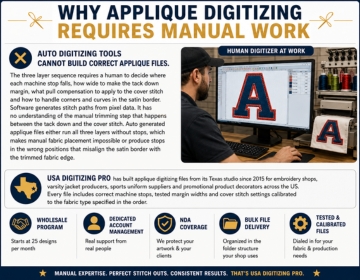
Auto digitizing tools cannot build correct applique files. The three layer sequence requires a human to decide where each machine stop falls, how wide to make the tack down margin, what pull compensation to apply to the cover stitch and how to handle corners and curves in the satin border. Software generates stitch paths from pixel data. It has no understanding of the manual trimming step that happens between the tack down and the cover stitch. Auto generated applique files either run all three layers without stops, which makes manual fabric placement impossible or produce stops in the wrong positions that misalign the satin border with the trimmed fabric edge.
USA Digitizing Pro has built applique digitizing files from its Texas studio since 2015 for embroidery shops, varsity jacket producers, sports uniform suppliers and promotional product decorators across the US. Every file includes correct machine stops, tested margin widths and cover stitch settings calibrated to the fabric type specified in the order. The wholesale program starts at 25 designs per month with dedicated account management, NDA coverage on client artwork and bulk file delivery in the folder structure the shop uses.
Who Uses Our Applique Digitizing Service
Varsity jacket producers are the heaviest users of applique digitizing in the US market. School letter jackets, athletic award jackets and collegiate outerwear all use sewn on applique letters and logos as the standard decoration method. A single varsity jacket order may include front letters, back numbers, sleeve emblems and interior name strips, each requiring a separate correctly sequenced applique file.
Sports team uniform suppliers use tackle twill applique digitizing for player numbers and team names on jerseys. Each number requires individual digitizing at the correct size and fabric type. Orders span full team rosters which means the same design may need to run at multiple sizes across an entire production batch.
Embroidery contract shops take on applique orders from clients who need the production work done without an in house digitizer available. Sending the design to USA Digitizing Pro for a production ready file means the shop can run the order immediately without delaying the client for an internal digitizing queue.
Pricing and Turnaround
Applique designs under 5 inches wide run a flat $15 with no additional fees for the three layer sequence, machine stops or the standard digital proof. Complex designs with multiple fabric layers, hybrid embroidered detail work or high stitch count borders are quoted above $25 before work begins. The quoted number is final with no surprise charges.
Turnaround for standard applique files runs 2 to 4 hours. Orders received before 3 PM CT ship the same business day. First time customers receive free rush service automatically. Every file ships with an unconditional money back guarantee. If the stitched sample doesn't match the digital proof, USA Digitizing Pro rebuilds the file or issues a full refund.
Frequently Asked Questions About Applique Digitizing
Standard embroidery digitizing covers design areas entirely with thread using fill, satin or running stitches. Applique digitizing uses fabric to fill the main design shape and thread only for the border and securing layers. Applique produces far lower stitch counts on large designs, which means faster machine runs, less thread consumption and a lighter flatter result on the garment. The tradeoff is that applique requires manual operator steps between machine stops, which adds hands on time that standard embroidery doesn't need.
Designs with large simple shapes, bold letters and clean geometric outlines translate well to applique. Designs with very fine detail, small text or complex curves with tight interior angles are harder to execute cleanly because the satin border can't follow intricate paths precisely without collapsing at sharp corners. Photorealistic designs and gradients don't work as applique at all. USA Digitizing Pro reviews every submitted design before digitizing and flags elements that may not suit the applique format, recommending adjustments before work begins.
Cotton twill, felt, woven polyester, fleece and denim all work well as applique materials. Felt is particularly popular for mascots and large fills because it doesn't fray and holds its shape under the satin border. Fabrics that fray heavily, like loosely woven canvas or open weave materials, need heat seal backing applied before the piece is cut. Stretch fabrics used as applique pieces require cut away stabilizer on the base garment to prevent the finished design from distorting after the hoop is released.
A standard single layer applique design requires two machine stops. The first stop follows the placement stitch so the operator can lay the fabric over the outline. The second stop follows the tack down stitch so the operator can trim the excess fabric before the cover stitch runs. Multi layer applique designs with two or more fabric pieces add one full set of stops per additional layer. Hybrid applique designs that include embroidered detail on top of the fabric surface may add further stops depending on the stitch sequence.
Yes but the base garment requires proper stabilizer to prevent distortion. Performance knit and jersey fabrics stretch in both directions. Running a dense applique border on an unstabilized stretch garment pulls the fabric around the design and distorts the shape. Cut away stabilizer hooped with the garment provides the structural support the fabric needs to hold flat during the run. The digitizing also needs lower density on the cover stitch than the same design on a non stretch fabric.
The stitch file works across similar fabric types without changes. Moving the same file from a cotton twill jacket to a fleece sweatshirt requires no file modification if the design size stays the same. Moving to a jersey or performance knit fabric changes the stabilizer requirements and may require a density adjustment on the cover stitch. If the garment fabric changes significantly, mention the new fabric type when reordering and a revised file can be built to match.
Get Your Applique Digitizing File Today
Applique delivers results that flat fill embroidery can't match on large designs. Lower stitch counts, faster machine runs and a finish that sits flat and washes clean run after run. The file has to be built correctly to deliver those results. A correctly sequenced applique file with calibrated tack down margins and properly compensated cover stitches runs without operator problems and produces consistent results across every garment in the production batch.
USA Digitizing Pro builds applique digitizing files manually for US embroidery shops, varsity jacket producers, sports apparel suppliers and branded merchandise decorators. Designs under 5 inches start at $15 flat. Complex work is quoted before it begins. Turnaround runs as fast as 2 to 4 hours.