

Custom Applique Patches: How Fabric and Thread Combine in One Patch File
By USA Digitizing Pro Team | Published November 2026 | Updated November 2026
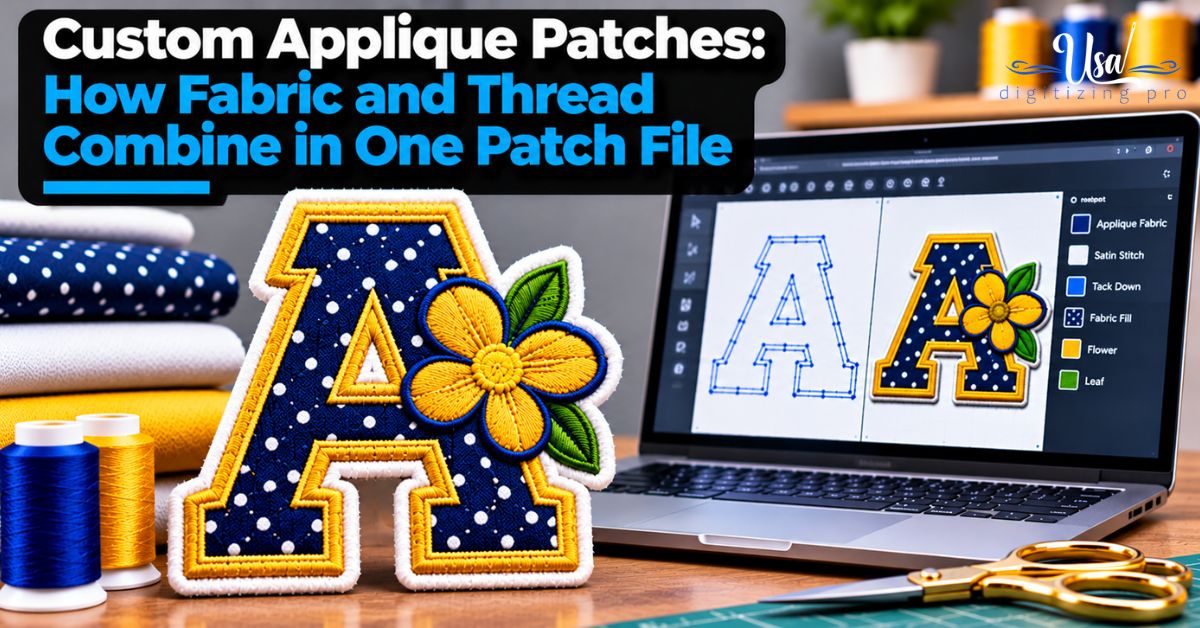
Look closely at big team letters, mascot patches and bold logos. The large areas often aren’t thread at all. They’re pieces of fabric, stitched down and finished with a satin edge. Custom applique patches use this method to cut stitch count, lower weight and add texture. This post explains how an applique patch file works, which fabrics to use, which borders fit and when applique beats a fully stitched patch. Files are built by hand through our applique digitizing services and patch digitizing services.
Quick Answer
Custom applique patches stitch a piece of fabric onto a patch base instead of filling large areas with thread. The file runs a placement line, a tack-down stitch, a pause to trim the fabric and a satin cover stitch over the raw edge. Applique cuts stitch count and weight on large designs and suits bold letters, numbers and mascots.
| Step in the file | What happens | Why it matters |
|---|---|---|
| Placement line | Marks where the fabric goes | Keeps fabric aligned |
| Tack-down | Holds the fabric in place | Stops shifting during sewing |
| Trim stop | Excess fabric is cut away | Leaves a clean shape |
| Cover stitch | Satin covers the raw edge | Hides fraying, gives a finish |
| Detail stitching | Adds text or inner details | Finishes the design |
| Border | Finishes the patch edge | Ready for cutting or merrowing |
Need an applique patch file? Email your design, patch size and fabric choice to art@usadigitizingpro.com.
What Is an Applique Patch?
A patch where one or more large areas are made from fabric pieces instead of thread fill. Thread holds the fabric down. Thread also finishes its edges.
Varsity letters, team names, big numbers and mascot bodies are the usual applique areas. Everything else, like fine text, can be normal embroidery.
How Does an Applique Patch File Work?
In a set order, with stops built in. Each stop gives the operator time to place or trim fabric. First the machine sews a placement line on the base. Fabric is laid over it. A tack-down holds it in place. Then the machine stops so the extra fabric can be trimmed close to the stitch line. A satin cover stitch wraps the raw edge last. Detail stitches and the patch border follow after that. The step-by-step settings are in how to digitize applique designs. Placement is covered in applique digitizing fabric placement.
Why Choose Applique for a Patch?
Big solid areas eat thousands of fill stitches. Fabric covers them faster. Lighter, too. And with a different texture. Large fills make patches stiff and heavy. They also take longer to sew. Applique swaps those fills for one piece of fabric, which means less thread, less machine time and a softer patch. Our post on applique digitizing stitch count reduction shows how much difference that makes.
Which Fabrics Work Best?
Stable woven fabrics that don’t fray much. For team letters, twill is the classic.
Felt cuts easily and doesn’t fray at all, which suits bold, simple shapes. Denim and canvas bring a rugged look. Stretchy or loose-weave fabrics are trouble, since they shift under the needle. Fabrics are paired with uses in our best fabric for applique embroidery post.
Which Edge Finish Should You Use?
Satin cover stitches give the cleanest finish. Zigzag and bean stitch edges look looser and more vintage. The satin cover has to be wide enough to hide the raw fabric edge completely. Narrow covers on fraying fabric let threads poke out after a few washes. The outer patch border is a separate decision (merrowed, satin or hot cut). Each option is compared in patch digitizing border types.
Applique Patch vs Fully Embroidered Patch: Which Is Better?
Applique for large, bold areas. Full embroidery for small, detailed designs.
| Factor | Applique patch | Fully embroidered patch |
|---|---|---|
| Large solid areas | Fabric, low stitch count | Thread fill, high stitch count |
| Weight and stiffness | Lighter, softer | Heavier, stiffer |
| Fine detail | Done in embroidery on top | Thread throughout |
| Texture | Fabric surface | Thread surface |
| Production steps | Extra stops for placing and trimming | No stops |
| Best for | Team letters, numbers, mascots | Small logos, detailed emblems |
The wider comparison beyond patches lives in applique vs embroidery.
What Sizes Suit Applique Patches?
Medium and large. Small shapes are fiddly to trim and don’t save many stitches anyway. Fabric shapes need enough size to place and trim cleanly. Thin parts of letters should still be wide enough for a full satin cover. Small text on the patch should stay at about 4mm tall or more. Otherwise, stitch it as a separate embroidered detail.
Picture a youth football league ordering 200 chest patches. The design has a large mascot head and the team name. The mascot’s face and helmet become two applique fabric pieces, with eyes and outlines embroidered on top. The team name is satin. That applique version runs faster and feels lighter than a fully filled patch the same size.
What Should You Send With the Order?
- Artwork, ideally vector, with applique areas marked.
- Patch size in inches.
- Fabric type and color for each applique area.
- Edge finish: satin, zigzag or bean stitch.
- Patch border type and backing.
- Your machine format or your producer’s format.
About the Author
USA Digitizing Pro Team. Applique and patch files have been built by hand here since 2015 for US teams, schools, uniform suppliers and patch makers.
Frequently Asked Questions
Applique patches use fabric pieces for large areas, while fully embroidered patches use thread for everything.
Not when a satin cover wide enough to hide the raw edge is used on stable fabric.
Tackle twill is the classic choice, with felt common for varsity-style designs.
Yes with heat-seal backing, though sewing lasts longer on uniforms and jerseys.
Often for large designs, since fabric replaces thousands of fill stitches.
Yes, large shapes use fabric while text and details are embroidered on top in the same file.
Order an Applique Patch File Built to Save Stitches
Custom applique patches use fabric for big areas and thread for edges and details. Stitch count drops. Weight drops too. Send your design, size and fabric choice to USA Digitizing Pro.
Follow Us

RELATED BLOGS
Left vs Right Sleeve Embroidery: Industry Placement Rules.
Published August 17, 2026 | By USA Digitizing Pro Team Ask three uniform buyers which sleeve the logo goes on and you'll.

Logo Digitizing for Small Businesses: 2026 Pricing Guide
A small business ordering its first embroidered logo usually has one question before anything else: what does this actually cost. Logo digitizing.