
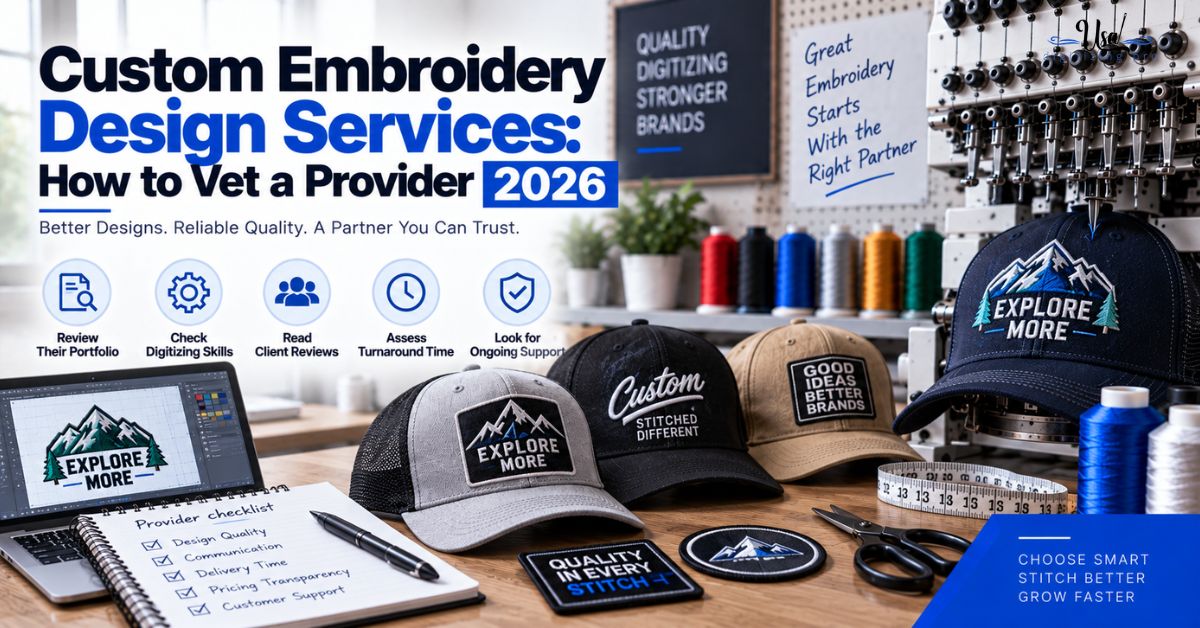
Custom Embroidery Design Services: How to Vet a Provider 2026
Published September 16, 2026 | By USA Digitizing Pro Team
Every provider of custom embroidery design services says the same things on their homepage: fast turnaround, expert digitizers, quality guaranteed. None of that distinguishes anyone. What actually separates providers is a handful of commercial terms most buyers never think to ask about until something goes wrong, and a couple of quality checks that take one small order to run. Here are the questions, what a good answer sounds like, and the answers that should end the conversation.
Quick Answer at a Glance
| Question to Ask | What a Good Answer Sounds Like |
|---|---|
| How many revisions are included? | Free revisions as standard, with minor and major defined |
| Who owns the finished file? | You do, and you can stitch it unlimited times |
| Which file formats do you deliver? | Whichever your machine reads, confirmed before starting |
| What is the turnaround? | A stated range, commonly a few hours for standard work |
| Can I see production samples? | Stitched pieces on fabric, not screen mockups |
| Do you ask about my fabric? | Yes, before quoting, because settings depend on it |
| What does digitizing cost? | Starting at $15 for designs under 5 inches |
What Custom Embroidery Design Services Actually Cover
The term covers more than one thing, and mismatched expectations here cause a meaningful share of disputes. Worth settling before comparing prices.
Digitizing Versus Design
Digitizing converts existing artwork into a stitch file. Design means creating artwork that did not exist before. Most providers advertising custom embroidery design services are primarily digitizers, and some also offer artwork creation or cleanup. If you need a logo drawn rather than converted, confirm that explicitly, since the skills and the pricing are different. the vector artwork service covers the artwork side of that split.
What Is Normally Included
A standard digitizing order typically includes building the stitch file, delivering it in your machine format, and revisions if something needs adjusting. Many providers include a stitch-out preview image. The file becomes yours to stitch as often as you like on any compatible machine, which is the normal arrangement across the US market.
What Usually Is Not
Physical sew-outs on your actual garment are often optional rather than standard, and worth requesting for large or complex orders. Artwork redraws, vectorization, and color separation for screen printing are usually separate services with their own pricing. Rebuilding a file for a different garment type also counts as new work rather than a revision, because the settings change.
The Questions That Separate Providers
These four are where providers genuinely differ, and where the differences only surface once you have already committed. Ask all four up front.
How Many Revisions, and What Counts as One
Reputable providers include free revisions as part of a standard order. The important part is the definition: what counts as a minor edit versus a major change, and how fast revisions turn around. A provider who charges for basic corrections, or takes days to respond to an edit request, will stall your production. Ask for both the policy and the revision turnaround, not just the policy.
Who Owns the File
Standard practice in the US market is that once you receive the file, you own it and can stitch it unlimited times on any compatible machine. What you typically cannot do is resell or redistribute the file as a digitizing product. If a provider is vague about this, or implies they retain the file and you license access to it, get the terms in writing before ordering. Businesses that do not hold their own files end up paying to have the same logo rebuilt repeatedly.
Which Formats Are Delivered
Most providers deliver in all major machine formats, but confirm your machine brand and model before ordering rather than assuming. A file in the wrong format is useless until someone converts it, and conversions are not always clean. State the format you need at the quote stage. the file format guide covers which format matches which machine.
What Is the Real Turnaround
Standard digitizing commonly turns around in a few hours across US providers, with complex work taking longer. Ask what the stated turnaround covers: is it from order to first file, or does it include the revision cycle. A two hour first delivery followed by a two day revision wait is not a two hour service in any way that helps your production schedule.
How to Judge Quality Before Committing
Marketing copy tells you nothing about stitch quality. Three checks do, and none of them require expertise to run.
Production Samples, Not Mockups
Ask to see stitched work rather than a portfolio of screen renders. On a real stitched piece you can check clean edges, solid fills, small text legibility, and whether threads were trimmed properly. A provider who only shows digital mockups is showing you artwork, not embroidery. how build quality shows in the finished stitch covers the specific markers to look at.
Why a Screen Preview Proves Nothing
A stitch preview shows the stitch paths the software generated. It cannot show registration on real fabric, thread coverage, whether small text closes up, or whether the fabric puckers. Everything that separates a good file from a bad one happens when the needle meets the garment. Judging a file on its preview is the single most common reason buyers approve something that fails in production.
The Small First Order Test
Before committing a full program to any provider, run one small order through them. That single job reveals communication speed, how they organize and name delivered files, whether the format was right, how the revision workflow actually works, and how the design behaves on a sew-out. It costs very little and tells you more than any amount of reading reviews.
Red Flags Worth Walking Away From
Three signals reliably predict problems later. None of them are about price.
Charging for Basic Corrections
If a provider treats fixing their own error as a billable revision, that cost compounds across every order you place. Corrections to a file that did not match the brief are not revisions, and a provider who blurs that line is telling you how the relationship will go.
Vague or Missing Ownership Terms
Ownership should be stated plainly and in writing. Ambiguity here is rarely accidental. A provider who will not confirm that you own the delivered file is creating a dependency, and the cost of that dependency shows up the day you want to work with someone else.
No Questions About Your Fabric
This one is technical rather than commercial and it is the most reliable quality signal of the three. Density and underlay depend entirely on the garment, so a provider who quotes without asking what fabric the design is going onto is not building for your garment. They are applying defaults and hoping. the settings behind common digitizing faults covers why that matters.
What You Should Supply
Vetting runs both ways. A provider can only build correctly from a complete brief, and an incomplete one produces revisions that are nobody’s fault but still cost you time.
Order Checklist
- Artwork as vector if possible, otherwise the highest resolution version you hold.
- Exact finished size in inches for the placement.
- The specific garment and fabric by name, not by category.
- The placement, such as left chest, cap front, or sleeve.
- Your machine format, plus needle count if color sequencing matters.
- Any brand color references that have to be matched precisely.
A Real Order, Broken Down
A Texas promotional apparel company moved digitizing to a cheaper provider and saved a few dollars per file. The first three orders arrived in the wrong machine format because nobody had asked which machine they ran. Revisions to fix files that did not match the brief were billed as revisions. When they later wanted to move the work elsewhere, the provider would not release the source files, so every design had to be rebuilt from scratch. The saving across eleven files was comfortably erased by one rebuild cycle. None of that was visible on the provider’s website, and all of it would have surfaced from the four questions above. the step by step digitizing process covers what a properly run build looks like.
Who Builds These Files
USA Digitizing Pro has run custom embroidery design services from its Texas studio since 2015, hand digitizing every file against the specific garment rather than applying defaults. Pricing starts at $15 for designs under 5 inches, with a 2 to 4 hour turnaround and a money-back quality guarantee. Service details are on the logo embroidery digitizing page, with cap-specific work covered on the cap digitizing page.
Frequently Asked Questions
Clear revision terms, written file ownership, delivery in your machine format, a realistic turnaround that includes revisions, stitched production samples rather than mockups, and a provider who asks what fabric you are stitching onto before quoting.
In standard US practice, yes. Once delivered, you own the file and can stitch it unlimited times on any compatible machine, though you generally cannot resell or redistribute it as a digitizing product. Get the terms in writing.
Reputable providers include free revisions as standard. Confirm how many are included, what counts as minor versus major, and how quickly revisions turn around, since a slow revision cycle stalls production regardless of the policy.
Standard designs commonly turn around within a few hours across US providers, with complex work taking longer. Ask whether the stated time covers only the first delivery or includes the revision cycle.
Digitizing converts existing artwork into a stitch file. Design means creating the artwork itself. Most providers are primarily digitizers, so confirm explicitly if you need artwork created rather than converted.
For large or complex orders, yes. A sew-out on actual fabric reveals registration, thread coverage, small text legibility, and puckering, none of which a screen preview can show.
Because density and underlay are set for the specific material. A file built for a stable woven commonly puckers on a knit, and no machine adjustment corrects it afterward.
Whichever your machine reads. Confirm your machine brand and model at the quote stage rather than assuming the provider will guess correctly.
Only if the commercial terms hold up. Savings per file disappear quickly against billed corrections, wrong formats, or rebuilding a logo because the original file was never released.
Vet Once, Then Stop Shopping
Choosing between custom embroidery design services is not really about comparing prices, because the prices across reputable US providers sit in a narrow band. It is about four commercial questions, three quality checks, and one small test order. Run those once, find a provider whose answers hold up, and the decision does not need revisiting. Skip them, and you find out what the terms were at the worst possible moment.
Follow Us

RELATED BLOGS
Custom Morale Patch: Types, Materials and How to.
USA Digitizing Pro is a Texas-based embroidery digitizing studio founded in 2015. The team handles stitch file production for apparel brands, tactical.
How to Choose Embroidery Stitch Type: The Width.
Published August 17, 2026 | By USA Digitizing Pro Team Most advice on choosing a stitch type stops at satin for narrow.