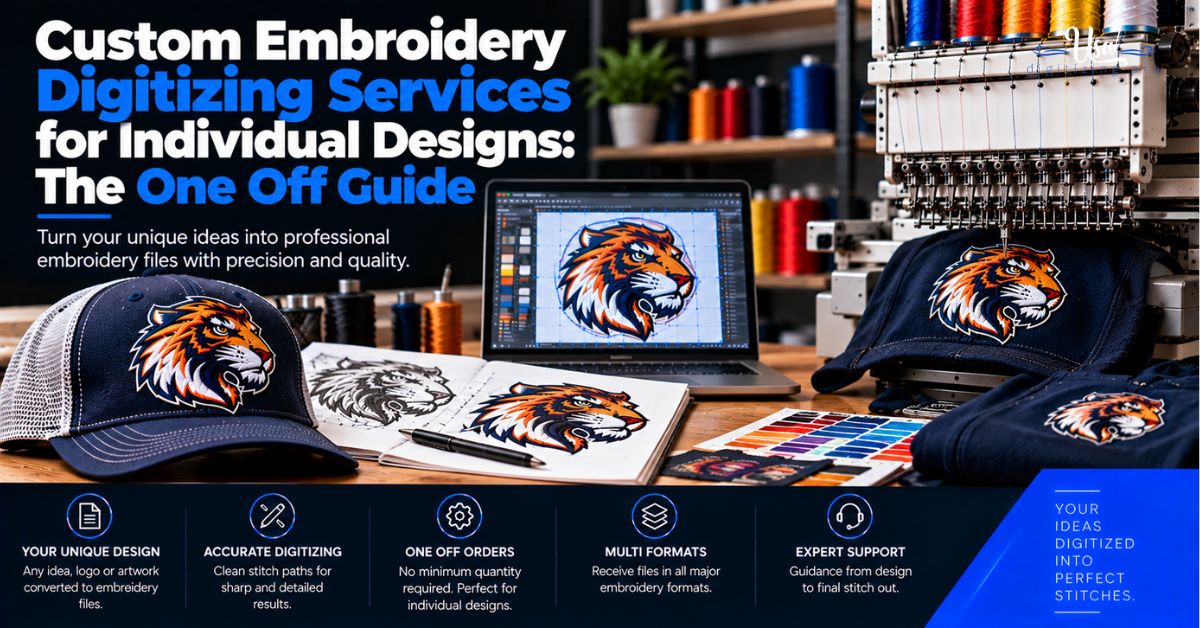
Custom Embroidery Digitizing Services for Individual Designs: The One-Off Guide 2026
Published October 16, 2026 | By USA Digitizing Pro Team
Custom embroidery digitizing services for individual designs are priced the same way they are for a company ordering 500 shirts. The setup is a setup, and it does not get smaller because you only want one. That is the first thing worth knowing if you are holding a child’s drawing, a grandparent’s signature, or a photo of a dog you loved, and wondering what this is going to cost.
The second thing worth knowing is that sometimes you should not do it, and almost nobody in this business will tell you that. This article covers both: what a one-off actually costs in the US, when it earns the money, the three times it does not, and what happens to each kind of personal artwork once it becomes thread.
Quick Answer at a Glance
Here is the picture in one place. Every third-party figure below is a published US provider rate and is attributed in the sections that follow.
| Question | Short answer |
|---|---|
| Is there a minimum order? | Often none. At least one major provider digitizes with no minimum. |
| Published setup fees | $2.95 to $6.50 at one provider, $20 at another, $35 at a third |
| Stitch-count pricing | Some vendors price by estimated stitch count, one covering up to 100,000 stitches |
| Typical range in cost guides | Roughly $20 to $75, treated as rough rather than authoritative |
| Share of a single-item price | On one shirt, digitizing can dominate the total |
| Is the file reusable? | Only if artwork, size, placement, garment, and settings all match |
| Color limit | Keep to five or six at most |
| Photos | Not directly. They need converting to line work with broad outlines first |
| Shadows and gradients | No embroidery equivalent exists |
Why a One-Off Is a Different Purchase
Everything written about digitizing assumes a business is buying it. Three things change when it is one person and one item.
Setup Does Not Spread
A company paying a $35 setup across 500 polos has spent seven cents a shirt. You paying the same $35 for one hoodie have spent $35. Independent cost guides make the same point, noting that for a single shirt the digitizing can dominate the price. Those guides are less authoritative than provider pages and the observation holds regardless.
This is not a complaint about pricing. Building a stitch file takes the same work whether one item or a thousand will be sewn from it. It just means the value question is different for you than for a business, and it deserves a different answer.
What US Providers Charge
The published range is wider than most people expect. Printful charges a one-time digitizing fee of $2.95 to $6.50 depending on the design and the placement, and does not require a minimum order. Figs charges a $20 digitizing fee, plus a per-item embroidery charge of $20 for black and white or $40 for full color on each order. Corporate Casuals charges a $35 setup fee and says you never pay it again for that artwork.
Some vendors price by complexity instead. One golf supplier bases the digitizing charge on estimated stitch count, with its listing covering up to 100,000 stitches. That approach is honest about what actually drives the work, which is how much is going on in the design rather than how many items you want.
The Reuse Clause Most People Misread
“Pay the setup once” is true with conditions, and the conditions are the part that catches people. A saved digitized file is reusable only if the artwork, size, placement, garment, and settings all match. Change the size and the density changes. Change the garment and the backing and pull compensation change. Both are explained in our notes on digitizing mistakes and their causes.
So if you digitize a design for a 3 inch chest placement on a sweatshirt and later want it at 6 inches on a canvas bag, that is a new build in practice even though the artwork has not changed. Worth asking about before you assume one payment covers everything you might ever want.
When a One-Off Is Worth It, and When It Isn’t
We build these files for a living and we will still tell you when not to buy one. Here are the two cases that earn the money and the three that do not.
Worth It: The Artwork Is Irreplaceable
A child’s drawing from the year they were six. A parent’s handwriting from a recipe card. A signature. A sketch somebody made who is no longer here to make another. None of that exists as a stock design and none of it ever will. This is the case where a one-off is obviously worth the setup, and it is covered more closely in our piece on turning handwriting and keepsakes into stitches.
The test is simple. If the artwork could not be replaced or bought, the cost of digitizing is not really the question.
Worth It: You Will Reorder the Same Thing
A family reunion shirt that happens every year. A small craft business putting the same mark on products. A sports club with the same logo on the same garment each season. Here the one-off becomes a multi-off and the setup genuinely does spread, as long as the size, garment, and placement stay the same.
Just be honest with yourself about whether you will really reorder. Most people who say they will, do not.
Not Worth It: A Generic Motif
If what you want is a flower, a holiday motif, a quilt block, an anchor, or an alphabet, stock designs already exist and cost a few dollars. Paying a setup fee to have one built from scratch is spending more for the same outcome.
The honest line is that a well-built stock design beats a rushed custom one and costs a fraction of it. Custom earns its money when the artwork is specific to you, not when it is a shape anyone could buy.
Not Worth It: One Item You Could Buy Already Decorated
If the goal is a single tote with a nice design on it, and the design is not personally meaningful, the whole chain of setup fee plus per-item embroidery is more expensive than buying something already made. Figs, for example, publishes a $20 digitizing fee plus $20 or $40 per item depending on color. On one item that stacks.
Buying finished is sometimes just the better purchase. Nobody loses anything by saying so.
Not Worth It: Artwork You Don’t Own
A character from a film. A team crest. A photo you found online. Guidance for personal embroidery work is explicit that someone else’s photo or copyrighted artwork needs permission first. A reputable studio will decline the job, and a studio that does not decline it is not protecting you. The licensing side of this is covered in our piece on pattern licensing and ownership. If you want something in that style, the clean route is commissioning original artwork and digitizing that, and silhouette art services is often the right starting point for portraits and pets.
Source Material Triage
Individual orders arrive as drawings, photographs, and handwriting rather than as clean logo files. Wilcom notes that over 90 percent of commercial embroidery orders are simple logo-style designs with flat colors and clear outlines, which tells you how unusual your artwork is in this pipeline. Here is what happens to each type.
Hand Drawings and Children’s Art
These convert well, and better than people expect. A line drawing made with marker has exactly what embroidery wants: clear outlines and flat areas. Crafters who have done this report that the results keep the character of the original, which is the whole point of the exercise.
What helps most is a clean photograph or scan of the drawing in good light, flat, with no shadow across the paper. Pencil is harder than marker because the line is faint and broken. If the original is pencil, do not trace over it yourself to darken it, since your line is not the child’s line and that is what you are trying to keep.
Photographs
Photographs do not become embroidery directly. Guidance is consistent that photo-like images fail automatic digitizing and have to become line drawings with broad outlines first. That conversion is a real piece of design work, not a filter, and it is the same category of job as cleaning up a raster image first.
What survives a photo is the silhouette and the biggest shapes. What does not survive is skin tone gradation, hair detail, soft shadow, and background. A pet portrait works because the animal has a strong outline and a few distinct color areas. A group photo of five people at a barbecue does not, at any price.
Handwriting and Signatures
Handwriting is one of the best candidates for this kind of work, and it has one hard limit. A pen line is thin, and embroidery has a floor of roughly 0.05 inches or 1.27mm for a usable line. Thinner than that and the stitch cannot hold it. That means handwriting usually has to be stitched larger than it was written, or its strokes thickened slightly, and which stitch is available at a given width is covered in stitch types and the widths they need and in our guide to choosing a stitch by width.
Thickening a signature is a judgment call, because too much and it stops looking like the person’s hand. Good work here is restrained.
Tattoos and Illustrations
Tattoo artwork often digitizes well, since tattoo design already obeys similar rules: bold outlines, limited shading, shapes that read at a distance. The catch is ownership rather than technique. The artist who drew it usually holds rights in the design, and your having it on your arm does not transfer those. Ask the artist.
Illustrations vary. Flat vector-style illustration is close to ideal. Watercolor, airbrush, and anything built on soft blending is not, because the thing being admired in the original is exactly the thing thread cannot do.
A Small Business Logo
If your individual design is your own logo for a small side business, you are in the easiest category and you also do not need a license for anything, since the artwork is yours. The relevant service is logo digitizing, and the only real decision is final size, because the file is built for that size and not for all sizes.
Triage Table
| Source | How well it converts | Main thing lost |
|---|---|---|
| Marker line drawing | Very well | Almost nothing |
| Pencil sketch | Moderate | Faint and broken lines |
| Pet or single-subject photo | Moderate, needs redrawing first | Fur detail, soft shading, background |
| Group or scenic photo | Poorly | Nearly everything that makes it a photo |
| Handwriting or signature | Very well, with size adjustment | True pen-line thinness |
| Tattoo or bold illustration | Very well | Fine shading, if any |
| Watercolor or airbrush | Poorly | The blending itself |
| Your own small business logo | Very well | Gradients, if present |
What Gets Simplified and Why
Every one of these jobs involves something being removed. Knowing what and why in advance means the proof does not come as a shock.
Color, Detail, and Effects
Three reductions are normal. Palettes come down, with guidance for personal work recommending no more than five or six colors. Effects go entirely, since drop shadows, gradients, and transparency have no embroidery equivalent, so software handles them poorly and a digitizer resolves them into flat areas instead. And fine detail gets enlarged or dropped, because very small intricate lines do not stitch cleanly and tiny details lose clarity at small sizes. Hoop size sets an outer boundary too, which our look at small hoop size limits covers, and the file you receive at the end will be in one of the machine file formats your embroiderer asked for.
The useful mindset is that embroidery is a translation rather than a copy. A good one keeps what made the original recognizable and lets the rest go, and deciding which is which is the actual skill being paid for.
Before You Order Checklist
Ten minutes with this list saves a revision and sometimes saves the whole purchase.
- Decide the finished size in inches, since the file is built for one size.
- Decide the exact garment or item, because backing and compensation depend on it.
- Photograph or scan the artwork flat, in good light, with no shadow across it.
- Send the largest, clearest version you have rather than a phone screenshot.
- Confirm you own the artwork or have permission.
- Count the colors and decide which could merge if needed.
- Identify the thinnest line and accept that it may need thickening.
- Ask which file format your embroiderer needs before ordering.
- Ask what happens if you later want a different size, so the reuse limits are clear.
- Ask for the file itself at delivery, not just the finished item.
A Real Order, Broken Down
A woman in New Braunfels sent us a drawing her son made when he was five. He is twenty-three now. She wanted it on a sweatshirt for his birthday, one sweatshirt, nothing more.
The drawing was a house, a sun, and four stick figures, in four marker colors on paper that had yellowed. Three things needed deciding. The paper color had to go, which sounds obvious and matters because a scan picks it up as a background shape. The stick figure arms were drawn with a nearly dry marker and measured under 0.03 inches in places, below the line floor, so they needed thickening to hold as stitches. And her son’s name was written in the corner in pencil, faint enough that it almost did not survive the scan at all.
We thickened the arms to just over the floor and no further, because the wobble in those lines is the whole charm and a confident line would have been a different drawing. The sun’s four colors stayed at four. The pencil name was the hard call. We stitched it as a single thin run at the smallest size it could hold, and it reads as a child’s pencil scrawl rather than as clean lettering, which is what she wanted.
One sweatshirt. One setup fee. She asked whether it was worth it for a single item and we said that in her case the question did not really apply, because nobody can produce that drawing again. For a holiday motif we would have told her to buy a stock design instead.
Who Builds These Files
USA Digitizing Pro has been building embroidery and vector files from a Texas studio since 2015. We take single-design orders, and we will tell you honestly if a stock design or a finished product is the better buy for what you are describing.
Digitizing starts at $15 for designs under 5 inches and $25 for designs above 5 inches, with 2 to 4 hour turnaround and a money-back quality guarantee. You get the file, not just a finished item, and we will tell you the size and garment it was built for so you know what it covers.
Reach us at sales@usadigitizingpro.com or +1 (830) 321-7832.
FAQ’s About Digitizing services for individual designs
Yes. Custom embroidery digitizing services for individual designs are widely available and at least one major provider digitizes with no minimum order at all. The work of building the file is the same whether one item or a thousand gets sewn from it, so a single design is a normal order rather than a special request.
Often not. Printful, for example, charges its one-time digitizing fee without requiring a minimum order. Some decorators do set minimums on the garments themselves rather than on the digitizing, so ask about both separately when you get a quote.
Keep it to five or six at most. Guidance for this kind of work recommends a small palette, and thread does not show subtle differences between similar tints anyway. Merging near-identical colors before the file is built usually improves the result rather than compromising it.
No, not without permission. Guidance for personal embroidery is explicit that someone else’s photo or copyrighted artwork requires permission first. That covers characters, team crests, and images found through a search. If you want something in a similar style, commissioning original artwork and digitizing that is the clean route.
Yes, with one adjustment. Embroidery has a minimum usable line thickness around 0.05 inches or 1.27mm, and most pen lines are thinner than that. So handwriting is usually stitched larger than it was written, or its strokes are thickened slightly. Good work here is restrained, since over-thickening stops it looking like that person’s hand.
Sometimes, and we will say when it is not. It is worth it when the artwork is irreplaceable, such as a drawing, a signature, or a sketch nobody can make again, or when you genuinely will reorder the same design on the same item. It is not worth it for a generic motif where stock designs cost a few dollars, for a single item you could buy already decorated, or for artwork you do not own.
One Item Deserves the Same Build
The economics of a one-off are simply different. There is no run to spread a setup across, which means the question is not whether digitizing is cheap but whether this particular artwork is worth building once. For a flower or a holiday motif the answer is usually no. For your mother’s handwriting it is not really a cost question at all.
Either way the build itself should be no different. The same decisions about line thickness, color reduction, stitch choice, and what gets simplified apply to one sweatshirt and to five hundred polos, and a studio that treats a single personal piece as a lesser job is telling you something useful about how it works. If you have a drawing, a signature, or a photo and you are not sure what it can become, email or call.
Follow Us

RELATED BLOGS
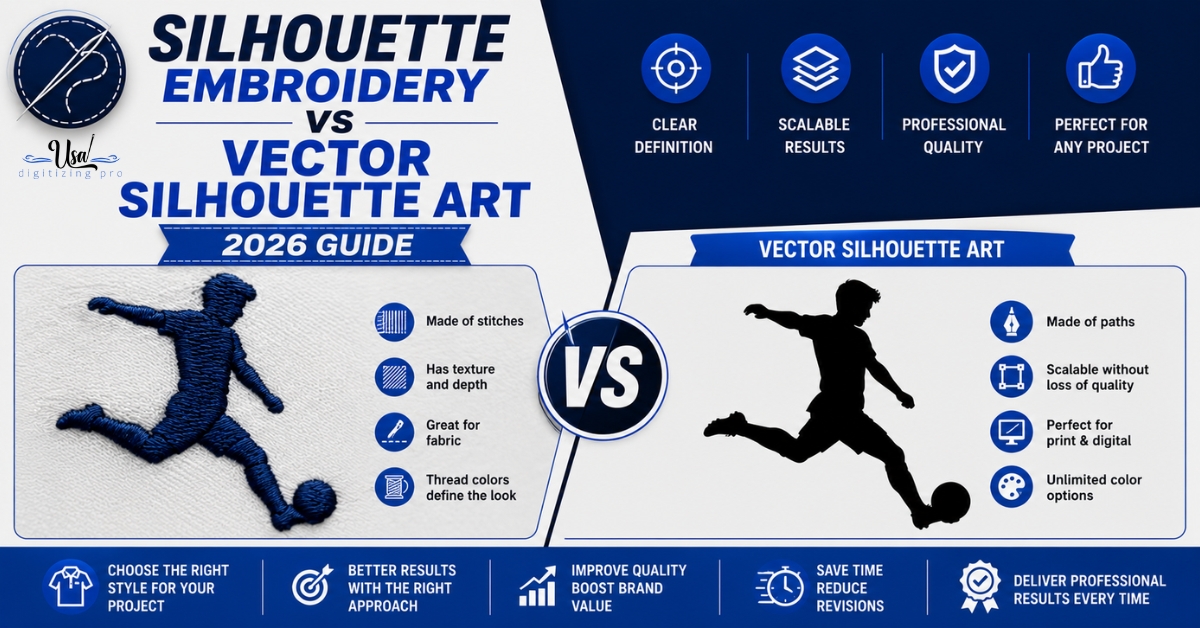
Silhouette Embroidery vs Vector Silhouette Art 2026 Guide
A silhouette design can end up on a garment two very different ways, and picking the wrong one leads to a finished.
3D Puff Embroidery Digitizing Tips: Foam and Width.
Published September 10, 2026 | By USA Digitizing Pro Team Puff either cuts clean or it makes a mess, and the difference.
2 COMMENTS
[…] same time, which moved the cheapest quote from third to first without anyone negotiating a rate. the vetting questions for design services covers the terms worth confirming alongside […]
[…] and whether the provider asks about your fabric before quoting all differentiate far more. the questions that separate digitizing providers covers the full vetting […]