

Stitching Identity With Hat Machine Embroidery: A Programme Guide 2026
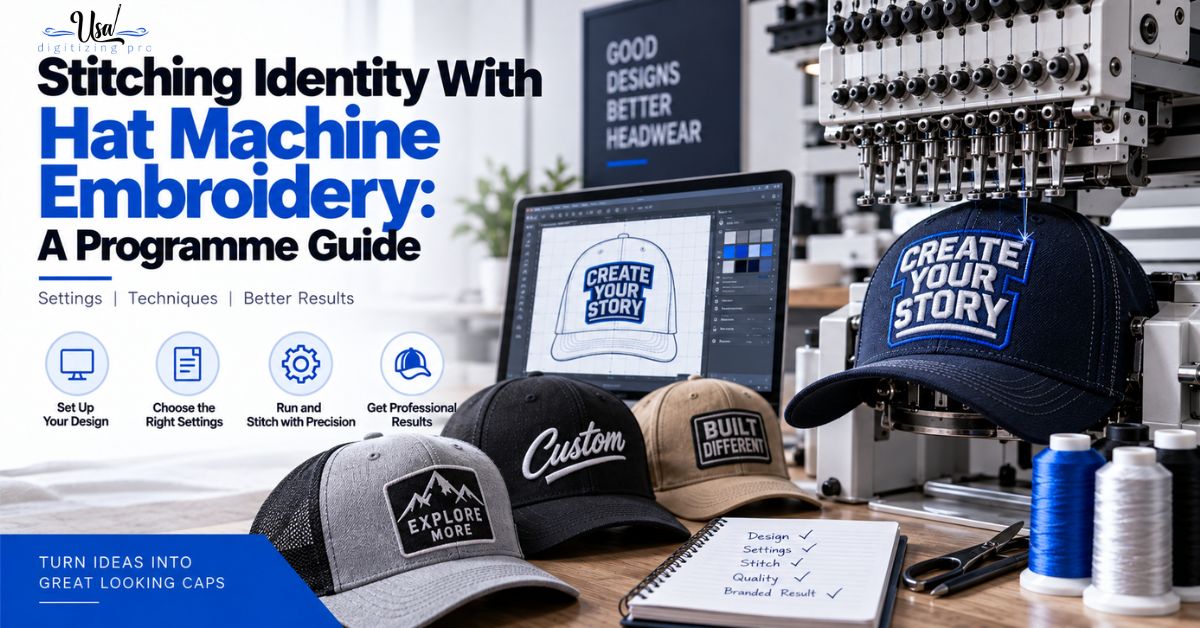
Published September 11, 2026 | By USA Digitizing Pro Team
A branded cap does something no other piece of company apparel manages. It sits at eye level, it reads from the front, the side, and from above, and people keep wearing it long after the shift ends. That makes headwear unusually effective as an identity asset and unusually unforgiving when the execution is wrong, because a logo that has gone slightly soft or shifted colour since the last order is visible on every head in the room.
Quick Answer at a Glance
| Question | Answer |
|---|---|
| Why hats over other branded apparel? | Visible from multiple angles and worn outside work hours |
| What matters most in the design? | Legibility at real viewing distance, not detail up close |
| Biggest programme risk? | Logo drift between the first order and the reorder |
| How is drift prevented? | Keep the digitized file and the colour references, reuse both |
| Do different hat styles share one file? | No, each construction needs its own build |
| Embroidery or print on caps? | Embroidery, for durability through daily wear and washing |
| What does cap digitizing cost? | Starting at $15 for designs under 5 inches, 2 to 4 hour turnaround |
Why Headwear Carries a Brand Further
The case for hats is not sentimental. It comes down to two properties no shirt or jacket shares in the same way.
Seen From Every Angle
A chest logo is visible when someone faces you. A cap front is visible when they face you, from the side, from behind if the back carries a mark, and from above when they are working at ground level. For field crews and service teams that last point matters more than it sounds, since customers frequently look down at someone working. US industry research on promotional products consistently ranks headwear near the top for impressions generated per item, behind only bags, with the long usable life of a cap driving the cost per impression very low over time.
Worn Off the Clock
Uniform shirts come off at the end of a shift. Caps get worn to the store, to the gym, and on weekends, which extends brand exposure well beyond working hours without any additional cost. That only holds when the cap is one people actually want to wear, which is an argument for spending slightly more on the blank and on a clean, well-executed logo rather than treating headwear as a throwaway giveaway.
What an Identity Programme Actually Needs
Three requirements separate a headwear programme that builds recognition from one that produces a box of caps. All three are decided before anything is stitched.
Recognisable at Real Viewing Distance
A cap logo is read from several feet away, not held at arm’s length. That changes what matters in the design entirely. Bold shapes, strong colour contrast, and clear letterforms carry at distance. Fine detail, thin outlines, and small taglines simply disappear, contributing nothing except stitch count. Judging the design at the distance it will actually be seen is more useful than judging it on a screen.
Consistent Across Every Reorder
A programme is not one order, it is an order now and another in six months when new staff start or stock runs out. If the second batch does not match the first, both are visibly wrong whenever they appear together. Consistency comes from reusing the same digitized file and the same colour references, which means keeping both somewhere the business controls. the file format guide covers what you should be holding.
Durable Through Daily Wear
Headwear takes more abuse than most branded apparel: sun, sweat, handling, and frequent washing. Embroidery holds up through that considerably better than printed alternatives, which is the main practical reason it dominates the category. A well-built file with appropriate density and underlay is what makes that durability real rather than theoretical.
Turning Identity Goals Into File Decisions
This is the bridge most branded headwear advice skips. Each of the three requirements above translates into something specific the digitizer has to do.
Legibility Beats Detail
A cap front offers roughly two inches of usable height, so the design is going to be simplified whether or not that is planned for. Deciding in advance what gets dropped protects the elements that make the brand recognisable. Usually the wordmark and the primary shape survive, and the tagline, the founding year, and fine internal detail do not. the cap design preparation guide covers simplifying artwork before it reaches the digitizer.
Colour Has to Be Referenced, Not Described
Navy is not a colour specification. Thread colours need to be recorded by their actual reference numbers so the reorder uses the same thread rather than a similar one. Brand colours that matter should be documented once and carried forward with the file. Where the logo also appears in print, keeping a vector master with documented colours keeps every medium aligned. the vector artwork service covers building that master.
One File Per Hat Style
A programme running structured caps for staff and unstructured caps for retail needs two files, not one. Panel construction changes how much density the fabric tolerates and how the design sits once worn. Reusing a single file across styles is the most common cause of a programme where some caps look right and others do not. the structured versus unstructured cap guide covers the differences, and the trucker hat digitizing guide covers the foam front variant.
Programme Types and What Suits Each
What the caps are for changes which style, which placement, and how much to spend per unit. These three cover most business programmes.
| Programme Type | Typical Choice | Priority |
|---|---|---|
| Field crews and service teams | Structured caps, front logo | Legibility at distance, durability |
| Retail and merchandise | Unstructured or trucker, style-led | Something customers want to wear |
| Events and giveaways | Lower cost blanks, simple marks | Volume and quick turnaround |
Field Crews and Service Teams
The goal here is instant recognition by a customer who may be some distance away and has never met the person before. Structured caps hold their shape and keep the logo upright and readable. The design should be the simplest version of the brand that still reads as the brand, and durability matters because these caps are worn daily in weather.
Retail and Merchandise
Merchandise caps have to compete with caps people would buy anyway, which means style choices matter as much as branding. Unstructured and trucker styles tend to suit this better than corporate structured caps. The logo can be subtler here, since the customer is choosing to wear it rather than being issued it.
Events and Giveaways
Volume and turnaround dominate. Designs should be simple enough to stitch quickly and legible enough to work at a glance in a crowded environment. This is the one programme type where a lower cost blank is usually the right call, though the file itself still needs building properly since it will likely be reused.
The Reorder Problem Nobody Plans For
Every headwear programme that runs longer than a year meets this, and almost nobody anticipates it at the first order.
Why Versions Drift
Six months after the first run, the reorder goes to a different supplier, or the original file cannot be found, or somebody sends a logo from the website instead. The new batch gets digitized fresh from whatever artwork was available. It looks close. Side by side with the first batch it is visibly not the same, and now the company has two versions of its own identity in circulation.
Keeping the File Set Intact
Preventing this costs nothing at the point of the first order. Ask for the digitized file in the formats your suppliers use, keep it somewhere the business owns rather than in a supplier’s account, and record the thread colour references alongside it. Do the same for each hat style in the programme. A short document listing which file goes with which cap style saves the entire problem. the logo embroidery digitizing service covers what gets delivered.
Setting Up a Programme
Running through this once at the start is what separates a programme from a series of unrelated cap orders.
Programme Checklist
- Decide what the programme is for, since crew, retail, and giveaway needs differ.
- Choose hat styles first, then have files built for each construction.
- Simplify the logo deliberately for a two inch cap front rather than letting it happen by accident.
- Record thread colour references, not colour names.
- Take delivery of the digitized files and store them under the business’s own control.
- Keep a sample cap from the first run as the physical reference for every reorder.
A Real Order, Broken Down
A Texas HVAC company issued branded caps to their install crews, and the first batch looked sharp. Eighteen months later they reordered through a different supplier, sending a logo pulled from their own website because nobody had the original file. The new caps came back with the tagline included, which the original had dropped for legibility, and in a slightly different blue. Crews ended up in two visibly different caps on the same job sites. Rebuilding from the vector master and documenting the thread references fixed it going forward, though the mismatched batch stayed in circulation for another year. The first order had cost them nothing extra to do properly. the cap digitizing page covers how files are delivered and what to keep.
Who Builds These Files
USA Digitizing Pro builds cap files for branded programmes from its Texas studio, simplifying artwork for the cap front deliberately and building a separate file for each hat construction in the programme. Pricing starts at $15 for designs under 5 inches, with a 2 to 4 hour turnaround and a money-back quality guarantee. Service details are on the cap digitizing page.
Frequently Asked Questions
They are visible from the front, the side, and from above, and people keep wearing them outside work hours, which extends exposure well beyond the working day. US industry research ranks headwear near the top of promotional categories for impressions generated per item.
Embroidery, in most cases. Headwear takes sun, sweat, handling, and frequent washing, and stitched logos hold up through that considerably better than printed ones.
Less than most people expect. A cap front gives roughly two inches of usable height, so fine detail, thin outlines, and small taglines disappear. Bold shapes and clear letterforms are what read at actual viewing distance.
Almost always because the second batch was digitized fresh from different artwork rather than run from the original file. Keeping the digitized file and thread colour references prevents it entirely.
Yes. Panel construction changes how much density the fabric tolerates and how the design sits once worn, so a structured cap and an unstructured one need separate builds.
The digitized file in the formats your suppliers use, the thread colour references, and a physical sample cap from the first run to compare future batches against.
Structured caps generally, because they hold their shape and keep the logo upright and readable at distance, which is what a customer-facing crew needs.
Identity Is the Reorder, Not the First Run
Anyone can get one batch of caps looking good. A headwear programme becomes an identity asset when the batch ordered eighteen months later is indistinguishable from the first, and that depends on decisions made before anything was stitched. Simplify deliberately for the space. Record colours by reference. Build a file per hat style. Then keep all of it under your own control, because the cap on someone’s head in two years is the one that decides whether the programme worked.
Follow Us

RELATED BLOGS
The Art of Vectorization: Six Judgment Calls Behind.
Published October 17, 2026 | By USA Digitizing Pro Team The art of vectorization is not conversion. Nothing converts. The file you.
7 Best Embroidery Digitizing Software: Who Each One.
Published October 21, 2026 | By USA Digitizing Pro Team Lists of the 7 best embroidery digitizing software tools almost always rank.