

Development of Embroidery Design in USA: Market and Shift 2026
Published October 2, 2026 | By USA Digitizing Pro Team
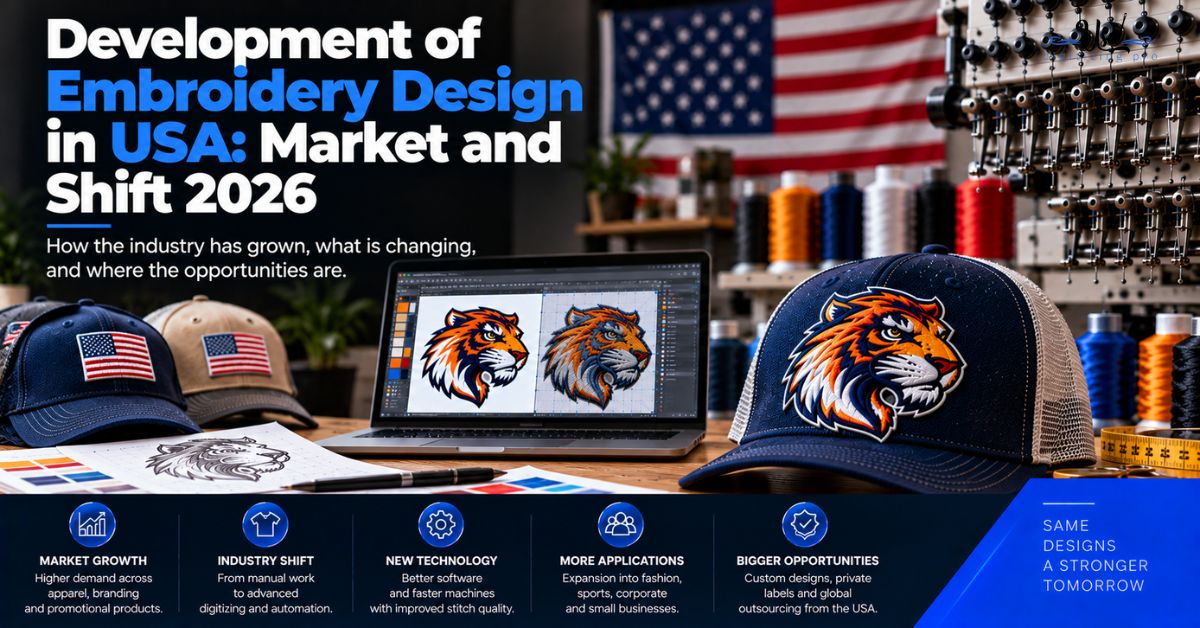
Most writing on this subject is history, which is interesting and does not help anyone making a decision. The development of embroidery design in USA is better understood through what the market is doing now: how large it is, what share embroidery holds within decorated apparel, which direction decoration methods are moving, and what any of that means for a business choosing where to have files built. Here is the current picture with the figures attached.
Quick Answer at a Glance
| Question | Answer |
|---|---|
| How big is the US decorated apparel market? | Around USD 12.63 billion in 2026 per Fairfield Market Research |
| What share of North America is that? | About 85.2 percent of the regional market in 2026 |
| Where does embroidery sit in the mix? | The leading product type, around 42 percent share in 2023 |
| Is the market growing? | Grand View Research projects a 13.2 percent CAGR from 2024 to 2030 |
| How digital is production becoming? | PRINTING United Alliance expects 47.1 percent using digital methods by 2026 |
| What drives demand? | Personalization, promotional apparel, and company branding |
| What does digitizing cost here? | Starting at $15 for designs under 5 inches, 2 to 4 hour turnaround |
Where the Development of Embroidery Design in USA Stands
Three figures establish the shape of the market, and all three come from published US research rather than from anyone’s marketing material.
Market Size and Share
Fairfield Market Research puts the US decorated apparel market at roughly USD 12.63 billion in 2026, representing about 85.2 percent of the North America regional market. Grand View Research valued the same US market at USD 5.11 billion in 2023, which gives a sense of how differently analysts scope the category. The useful takeaway is not a precise number, it is that the US dominates its region by a wide margin.
Embroidery’s Position in the Product Mix
Within decorated apparel, embroidery led the product type segment at around 42 percent share in 2023, driven by personalized and promotional apparel. That matters because embroidery is frequently discussed as the traditional method being displaced by newer ones, and the data does not support that framing. It is the largest single category in the mix. why embroidery holds up where printing does not covers the durability argument behind that.
Growth Direction
Grand View Research projects the US decorated apparel market growing at a 13.2 percent compound annual rate from 2024 through 2030. Analysts attribute US dominance in the regional embroidery market to demand for customized clothing, sportswear, and company branding, alongside strong consumer spending. The direction is expansion rather than contraction, which is worth knowing if you are deciding whether to invest in a branded apparel program.
The Shift Toward Digital Decoration
The more interesting development is methodological rather than financial, and it is often misread.
What the Adoption Figures Say
PRINTING United Alliance figures cited across industry reporting expect 47.1 percent of decorated apparel production to incorporate digital methods by 2026. Automated embroidery machines and digital printing have both made customization more accessible and more cost effective, particularly at small run sizes that were uneconomic a decade ago.
What Digital Does Not Replace
Incorporating digital methods is not the same as replacing embroidery. Digital printing suits full color photographic work and very short runs. Embroidery suits anything needing durability through daily wear and washing, and anything where a stitched finish carries the perceived value. The two have been growing alongside each other, which is why embroidery held the largest product share while digital adoption climbed. which method suits which product covers the durability comparison.
What Is Driving Demand
Two demand sources account for most of the growth, and they ask for different things from a supplier.
Personalization and Small Runs
Research consistently attributes embroidery’s lead to personalized and promotional apparel. Small runs, one-off pieces, and short-notice orders are now economically viable in a way they were not when setup costs dominated. That changes what matters in a supplier relationship, because a one-piece order with a slow file turnaround is a worse experience than a slow quote on a thousand-piece run.
Company Branding and Uniform Programs
The other driver is business branding: uniforms, crew apparel, corporate merchandise, and the headwear programs that go with them. These are repeat relationships rather than transactions, which puts weight on consistency across reorders and on holding the files that make that consistency possible. what a branded program needs to stay consistent covers the reorder problem specifically.
What Domestic Turnaround Actually Changes
This is the practical consequence of a US-based market being served partly from elsewhere. The argument for domestic work is not patriotic, it is about cycle time.
The Approval Cycle
Digitizing is rarely one exchange. There is a file, often a sample, sometimes a revision, and each step is a round trip. When those round trips happen inside one working day, a design can be ordered in the morning and approved by the afternoon. When each step waits for the other party’s next working day, the same three exchanges become three days regardless of how fast the actual work is.
Shared Working Hours
Overlapping business hours means a question about fabric or placement gets answered during the conversation rather than queued. On straightforward orders this is irrelevant. On anything with an unusual garment, a tricky placement, or a client deadline, the ability to resolve an ambiguity in ten minutes rather than overnight is the whole difference between hitting a date and missing it.
Fabric and Blank Familiarity
A digitizer who works daily with the blanks sold in the US market knows how a given cap or polo behaves without having to ask. That shows up in density and underlay set correctly first time rather than after a sample. Analysts have noted domestic and nearshore vertical integration as a durable advantage for early movers, and this is part of why. why fabric knowledge decides the file settings covers what goes wrong without it.
What This Means When Choosing a Supplier
Market direction is only useful if it changes a decision, so here is where it does and where it does not.
Where Speed Matters and Where It Does Not
If you plan programs months ahead and order in large batches, turnaround is close to irrelevant and you should optimize for file quality and commercial terms. If you take short-notice orders, run small batches, or serve clients with event deadlines, cycle time is a genuine operational constraint and worth paying for.
What to Compare Instead of Price Alone
Per-file prices across reputable US providers sit in a narrow band, so comparing on price alone separates very little. Revision terms, file ownership, format delivery, and whether the provider asks about your fabric before quoting all differentiate far more. the questions that separate digitizing providers covers the full vetting list.
Positioning Your Own Program
For a decorator or a brand running apparel, the market data points at a few concrete planning decisions.
Planning Checklist
A Real Order, Broken Down
A Texas decorator took a Friday afternoon order for forty caps needed the following Thursday for a trade event. Artwork arrived at two in the afternoon, the digitized file came back the same afternoon, a cap sample ran Monday morning, one density adjustment was requested and returned within the hour, and production ran Tuesday. The same sequence with overnight round trips would have put the sample on Wednesday and the production run after the event. Nothing about the actual work was faster. The exchanges simply happened inside the same working day. what to supply so the first file is right covers reducing the number of exchanges needed.
Who Builds These Files
USA Digitizing Pro has operated from its Texas studio since 2015, working in US business hours with the blanks the US market actually sells. Pricing starts at $15 for designs under 5 inches, with a 2 to 4 hour turnaround and a money-back quality guarantee. Service details are on the logo embroidery digitizing page and the cap digitizing page.
FAQs About Development of embroidery design in USA
Fairfield Market Research puts it at roughly USD 12.63 billion in 2026, about 85.2 percent of the North America regional market. Grand View Research valued it at USD 5.11 billion in 2023, so scoping differs between analysts.
The wider decorated apparel market is projected to grow at a 13.2 percent compound annual rate from 2024 to 2030 per Grand View Research, with US demand driven by customized clothing, sportswear, and company branding.
Embroidery led the product type segment at around 42 percent share in 2023, driven by personalized and promotional apparel, which makes it the largest single category rather than a declining one.
Not replacing. PRINTING United Alliance figures expect 47.1 percent of production to incorporate digital methods by 2026, while embroidery held the largest product share over the same period. They serve different purposes and have grown alongside each other.
Automated machines and digital methods made small runs and one-off pieces economically viable, where setup costs previously made them impractical. That opened demand that did not exist at scale before.
It matters to cycle time rather than to file quality in principle. Approval rounds completing inside one working day instead of waiting overnight is the practical difference, which matters on short-notice work and barely at all on long-planned programs.
When you plan months and order in large batches. In that case optimize for file quality, revision terms, and file ownership instead.
Revision policy, file ownership in writing, delivery in your machine format, realistic turnaround including revisions, and whether they ask about your fabric before quoting. Per-file prices across reputable providers sit close together.
A Growing Market With Shorter Cycles
The development of embroidery design in USA comes down to a large market, growing, and still led by embroidery within decorated apparel, while production steadily incorporates more digital methods alongside rather than instead of stitching. For anyone buying, the practical consequence is that small runs and short-notice work are now normal, which makes cycle time a real operational variable rather than a marketing line.
Follow Us

RELATED BLOGS
4×4 Embroidery Hoop: Size Limits and Pricing Guide.
A 4x4 embroidery hoop is the most common hoop size in commercial embroidery and most left chest logos small caps and single.

Applique Digitizing Stitch Count Reduction: Techniques That Work.
Published August 17, 2026 | By USA Digitizing Pro Team Switching a large design from full embroidery to applique cuts stitch count.