

Embroidery Digitizing and Vector Artwork: Which You Need 2026
Published September 21, 2026 | By USA Digitizing Pro Team
Embroidery digitizing and vector artwork get sold side by side, which leads plenty of buyers to assume they are two names for the same job. They are not, and the assumption costs real money in both directions: ordering the wrong one, or ordering both in the wrong sequence and paying to redo work. The distinction takes a paragraph to explain and the ordering logic takes a little longer, because that is the part nobody covers.
Quick Answer at a Glance
| Your Situation | What to Order | Why |
|---|---|---|
| Embroidery only, clean vector already held | Digitizing | The source artwork is already usable |
| Embroidery only, no vector exists | Vector, then digitizing | The digitizer needs defined boundaries |
| Print, signage, or promo only | Vector artwork | Nothing gets stitched, so no stitch file is needed |
| Embroidery and print | Both, vector first | One master feeds print and the digitizing |
| Reorder of an existing stitched design | Neither, if you hold the file | The stitch file is reusable indefinitely |
| Digitizing here | Starting at $15 under 5 inches | 2 to 4 hour turnaround |
What Embroidery Digitizing and Vector Artwork Each Produce
Both services start from your logo and produce a file. The files do entirely different jobs, and knowing what each output is makes the rest of the decision obvious.
Digitizing Produces a Stitch File
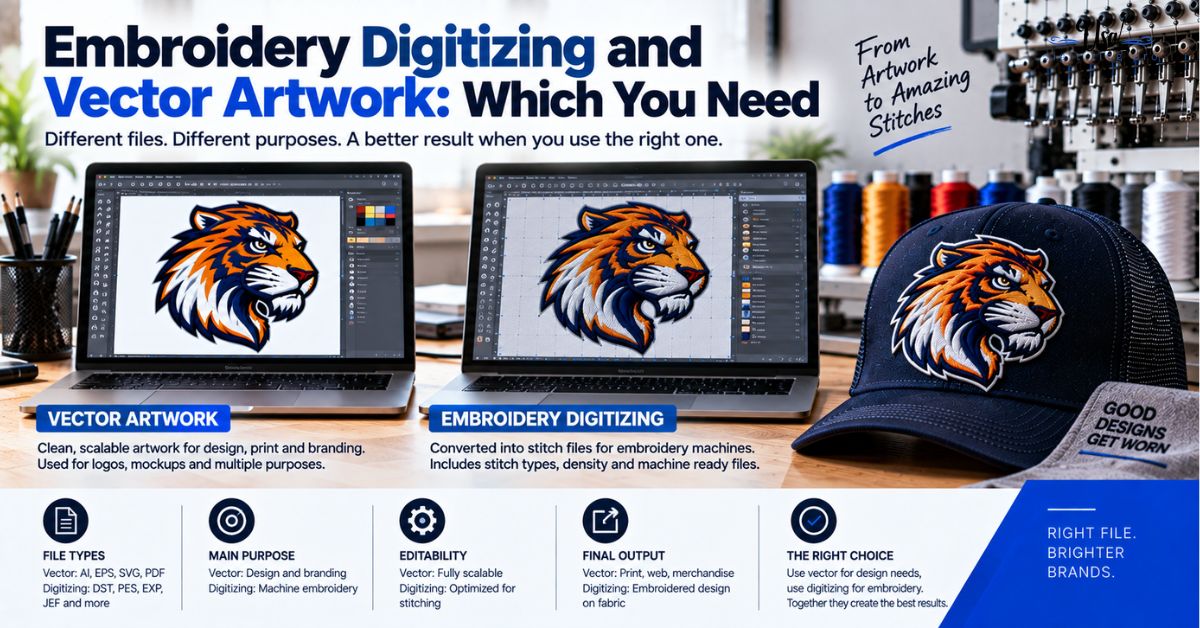
Digitizing converts artwork into a machine-readable stitch file, in a format like DST or PES, that tells an embroidery machine where to place every stitch, in what order, and in which direction. The output only makes sense to an embroidery machine. It is not a picture, it is a sequence of instructions. what a digitizer decides while building it covers what goes into that conversion.
Vector Produces a Scalable Graphic
Vector conversion produces a scalable graphic file, typically AI, EPS, or SVG, built from mathematical paths rather than pixels. It scales to any size without losing quality and feeds print, signage, screen printing, packaging, web, and promotional products. It also serves as the cleanest possible source for digitizing. what each production method needs from vector covers the downstream uses.
Neither File Substitutes for the Other
A stitch file cannot be printed, resized meaningfully, or opened as artwork. A vector file cannot be sent to an embroidery machine, because it contains shapes rather than stitch instructions. The clearest summary available is that vector prepares and preserves the logo while digitizing produces it on a machine. Those are separate jobs with separate outputs.
Which One Your Job Needs
Three situations cover almost every order, and identifying which one you are in answers the question immediately.
Embroidery Only
If the design is going onto garments and nowhere else, you need digitizing. Whether you also need vector first depends entirely on what artwork you currently hold. A clean vector file means the digitizer can start straight away. A low resolution image means someone has to establish the boundaries before stitches can be assigned, and that is vector work whether it is billed separately or absorbed into the digitizing quote.
Print, Signage, or Merchandise Only
If nothing is being stitched, you do not need a stitch file. Screen printing, signs, decals, packaging, and promotional products all run from vector. Ordering digitizing for a job with no embroidery in it is straightforwardly money spent on a file nobody will use.
Both, Which Is More Common Than People Expect
Most businesses that order embroidery also order print eventually. Shirts and signage. Caps and decals. Uniforms and business cards. When both are in the picture, you need both file types, and the vector master is what keeps them consistent with each other over time. building one master file for every application covers holding a single source of truth.
The Ordering Sequence That Saves Money
This is the part that gets missed, and it is the difference between paying once and paying twice.
Why Vector Comes First
Vector is the source. A digitizer works best from defined boundaries, so a clean vector file produces a better stitch file with fewer assumptions and fewer revisions. Build the vector first, then digitize from it, and the same vector goes on to serve your print work. One piece of artwork preparation feeds everything downstream.
What Happens If You Reverse It
Order digitizing first from a poor quality image and two things happen. The digitizer interprets soft boundaries, which may or may not match what you intended. Then, when print work comes up later, you still need a vector file, and it gets built from the same poor source rather than from anything the digitizing produced. You have paid for boundary interpretation twice and the two results may not match. how to judge whether a vector file was built properly covers what a good source file looks like.
The Two Assumptions That Cost the Most
US sources note both of these as common buyer errors, and each one produces the same conversation with a vendor a few days before a deadline.
Assuming Vector Can Be Stitched Directly
An embroidery machine cannot read AI, EPS, or SVG. Holding a beautiful vector master does not mean you are ready to stitch, it means you are ready to digitize. This surprises people who were told vector is the universal format, which is true across print and untrue across embroidery.
Assuming a Stitch File Can Be Printed
The reverse error is sending a DST or PES to a printer or a sign shop. A stitch file contains needle coordinates rather than artwork, so there is nothing there to print. If embroidery was your first decorated product and the stitch file is all you were given, you do not currently have usable artwork for anything else. what to keep after a digitizing order covers the file set worth holding.
Working Out What to Order
Four questions settle it, and they take less than a minute to answer honestly.
Decision Checklist
- Is anything being stitched? If yes, digitizing is required.
- Is anything being printed, cut, or produced as merchandise? If yes, vector is required.
- What artwork do you actually hold right now, and is it vector?
- If no vector exists and embroidery is needed, order vector first, then digitizing from it.
- If you already hold a stitch file for this design and the garment is unchanged, order neither.
- Confirm you take delivery of both files, since both get reused indefinitely.
A Real Order, Broken Down
A Texas landscaping company ordered digitizing for crew shirts using a logo pulled from their old website, which was a low resolution PNG. The stitch file came back acceptable, with a few fine details simplified because the source boundaries were soft. Three months later they needed truck decals and a yard sign, and the sign shop asked for vector. The stitch file was useless for that, so the logo had to be vectorized from the same poor PNG, and the vector rebuild interpreted two details slightly differently from how the digitizer had. The shirts and the signs now carry marks that do not quite match. Vectorizing first would have cost the same total and produced one consistent logo across both. what to send when ordering digitizing covers the brief that goes with either service.
Who Builds These Files
USA Digitizing Pro provides both services from its Texas studio, which means a single source of artwork can feed your stitching and your print work without two separate interpretations. Pricing starts at $15 for designs under 5 inches, with a 2 to 4 hour turnaround on digitizing and a money-back quality guarantee. Details are on the logo embroidery digitizing page and the vector artwork page.
Frequently Asked Questions
Digitizing converts artwork into a machine-readable stitch file for an embroidery machine. Vector conversion produces a scalable graphic file for print, signage, and design use. Vector prepares and preserves the logo, digitizing produces it on a machine.
No. An embroidery machine cannot read AI, EPS, or SVG. Vector is the ideal source for digitizing, and it still has to be converted into a stitch file before anything can be stitched.
No. A stitch file contains needle coordinates and sequencing rather than artwork, so there is nothing in it for a printer or sign shop to use.
If your design goes onto both stitched and printed products, yes. Many businesses end up needing both eventually, which is why the vector master is worth having even when the first order is embroidery.
Vector first, then digitizing from it. The vector becomes the single source for both the stitch file and all your print work, which keeps the two consistent.
The digitizer interprets boundaries from whatever source you supplied. When print work comes up later, the vector still has to be built from that same source, and the two interpretations may not match.
No, provided you hold the stitch file and the garment has not changed. Stitch files are reusable indefinitely, which is a strong argument for taking delivery of yours.
Two Services, One Source of Truth
Embroidery digitizing and vector artwork answer different questions. Is this being stitched, and is this being printed. Plenty of businesses answer yes to both, and the ones that save money are the ones who build the vector first and let everything downstream come from it. Order in that sequence and one piece of artwork preparation serves every decorated product you will ever make.
Follow Us

RELATED BLOGS
Logo Digitizing Process: A 2026 Step By Step.
You sent a logo. The shop sent back a polo with thread breaks and fuzzy letters. Sound familiar? Most cap and apparel.
Sleeve Embroidery Size Limits by Garment: What the.
A sleeve isn't a flat panel, and the hoop that holds it in place while it stitches isn't square either. Sleeve embroidery.